On my first visit to Paris, one of the monuments that struck me most was the splendid Sainte-Chapelle, the palatine chapel of King Louis IX, also known as Louis the Saint.
The Sainte-Chapelle is a true masterpiece of Gothic art, unique in the world. Its stained-glass windows are among the most beautiful I have ever seen and they make it, without doubt, one of the monuments you have to see in Paris. The emotion of stepping inside is always overwhelming, and I’m sure it can’t leave anyone indifferent.
It was built from 1241 and its purpose was very particular from the start: to house the Crown of Thorns of Jesus and the other precious relics the sovereign had bought. Once it was joined to the royal palace, while today it is embedded in the Palais de Justice of Paris.
If you’re thinking of visiting it, here’s some practical information!
The ticket costs €16 if you are a national or resident of the European Economic Area and €22 if you are not (the rate in force since 12 January 2026), and is free for under-18s (and for EU residents aged 18–25). Given the huge crowds and the hours you risk spending in the queue, I suggest booking online a tour with tickets for the Sainte-Chapelle and the Conciergerie, so you skip the line and also visit the old royal palace right next door.
But why visit it and what is there to see inside?
Now I’ll tell you.
Let’s go!

History of the Sainte-Chapelle
The Sainte-Chapelle is one of the most beautiful Gothic buildings in Paris and, perhaps, in all of France. What is truly astonishing is the speed with which it was built: the project was begun around 1241 and just seven years later, in 1248, the king’s chapel had already been consecrated.
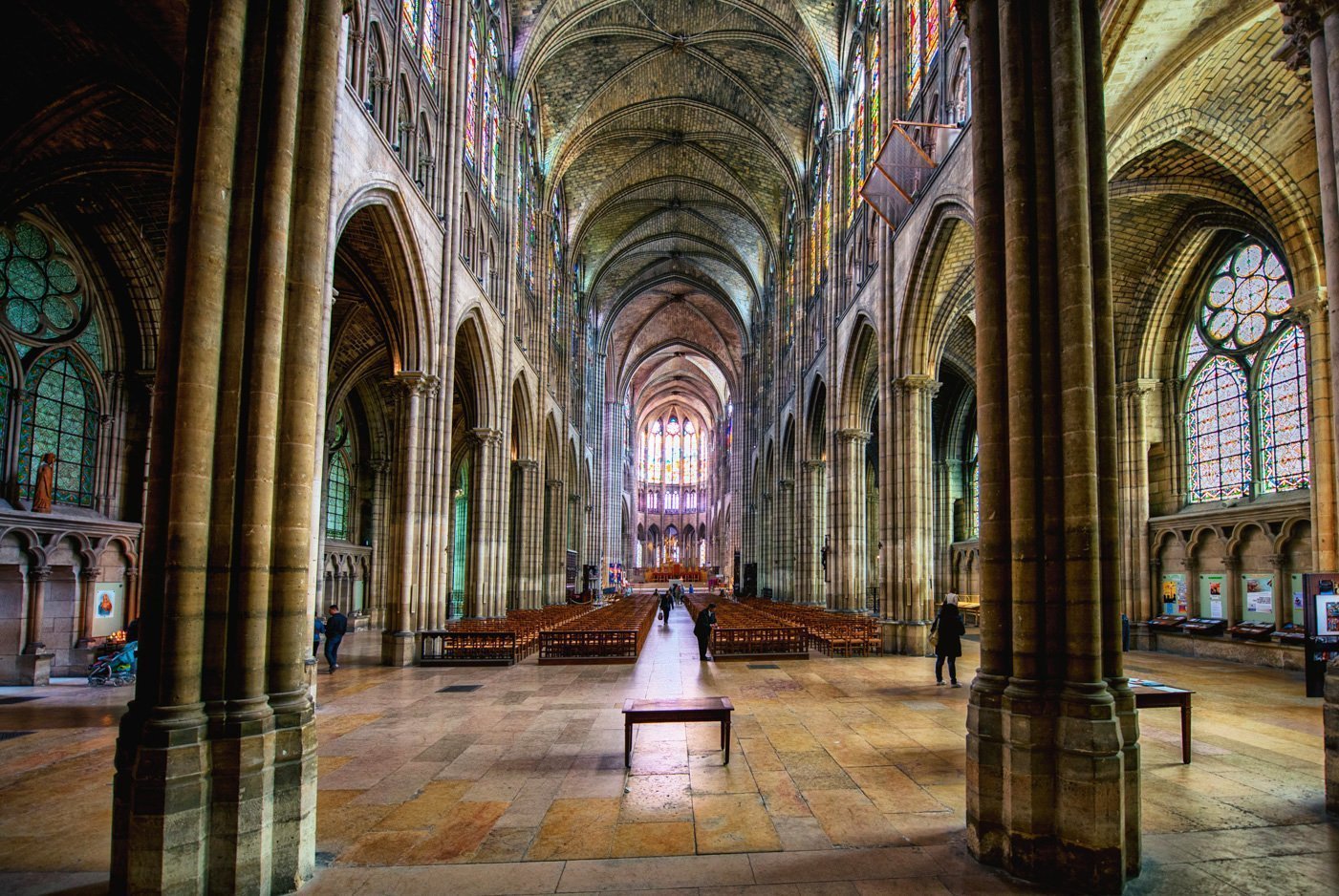
The architect is traditionally identified as Pierre de Montreuil (the same man who also worked at Saint-Denis, the church that holds the remains of the kings of France), although the attribution remains uncertain.
As I was saying, King Louis IX wanted a chapel for his palace that would hold the sacred relics of the Passion, first among them the Crown of Thorns. And here comes the surprising part: if building the chapel was hugely expensive, the price of the relics was more than three times as much.
But where did these relics come from?
The Crown of Thorns was not at all “gathered from around the world”: Louis IX bought it in 1239 from Baldwin II, the Latin Emperor of Constantinople who, short of money, had even pawned it to the Venetian bankers. The king paid about 135,000 livres tournois, almost half the kingdom’s annual budget.
Why such a mad expense? Louis IX was a deeply devout ruler, but with that purchase the fame of Paris grew enormously: the city became a new “Jerusalem of the West”, and the king was later proclaimed a saint.
Here’s a curiosity.
Today the Sainte-Chapelle no longer holds any relic. The great silver shrine that contained them was melted down during the French Revolution, but the Crown of Thorns survived: in 1806 it was moved to the treasury of Notre-Dame Cathedral, rescued from the flames during the 2019 fire and, after the cathedral’s reopening, it returned there in December 2024, where it is shown to the faithful every Friday.

The lower chapel
As soon as you enter the Sainte-Chapelle, you may feel a little disappointed: the lower chapel is in fact very modest.
All the walls are decorated with the symbols of the king of France and those of his mother, Blanche of Castile (of whom I’ll tell you shortly), and the only decorations you’ll find are a statue of the Virgin and some 13th-century frescoes, among the oldest wall paintings in Paris.
The real treasure, instead, is on the upper floor.
Here’s what awaits you.

The stained-glass windows of the Sainte-Chapelle
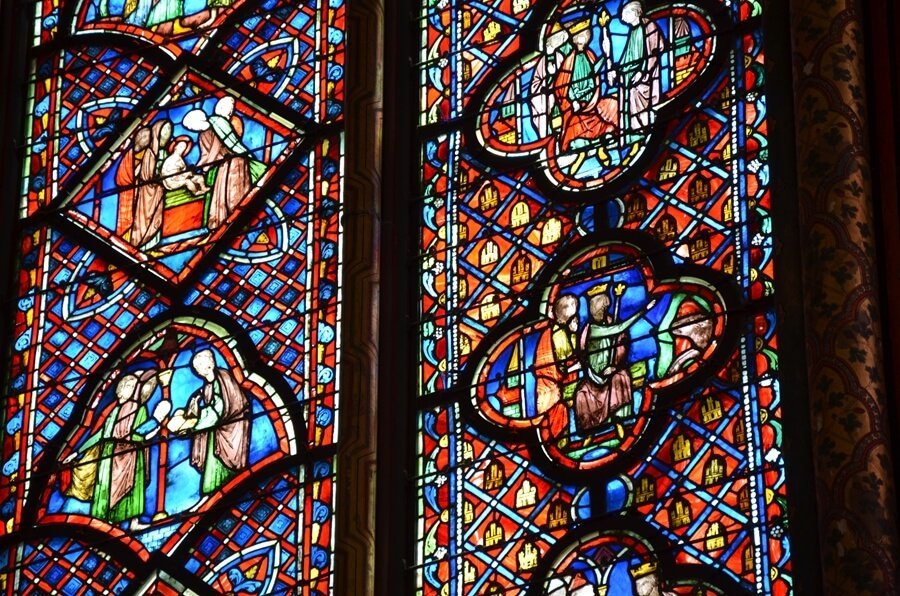
When you reach the upper floor, a sight you’ve never seen before will open up in front of your eyes. Here there are 15 huge windows, 15 metres high, with more than 1,100 scenes, leaving so little room for the load-bearing structure that the chapel seems to stand by a miracle, like a cage of glass and light.
The light that filters through is truly striking and gives the whole an extreme elegance.
It is almost by chance that the windows of the Sainte-Chapelle have come down to us in good condition. The French Revolution caused the destruction of a great many religious works, especially in Paris: luckily, here the windows were largely protected because the chapel had been turned into an archive, and the panels were hidden by the shelves of the Palais de Justice. In the mid-nineteenth century a great restoration (led among others by Jean-Baptiste Lassus and the famous Viollet-le-Duc) brought them back to their original splendour and rebuilt the spire you still see today.
About two-thirds of the windows are original to the 13th century and tell biblical stories: they begin with Genesis (the first window to the left of the altar) and end with the Apocalypse of John (in the great rose window, which is however later).
One of the windows recounts the finding of the True Cross by Saint Helena, mother of Constantine, the first Christian emperor, and even the story of the relics’ arrival in Paris and of the building of the Sainte-Chapelle itself: a not-so-veiled way of comparing Louis IX to Constantine.

Symbolism and numerology
An interesting detail for understanding Louis IX’s personality are the symbols of the lily and the castle on the columns. The lily, symbol of the French sovereigns, refers to Louis IX’s father, while the castle is the emblem of the house of Castile to which his mother Blanche belonged.
But there’s more!
It has been suggested that the building of the Sainte-Chapelle follows a precise symbolic and numerological scheme. The length from the apse to the porch is said to measure 100 feet, just as the Old Testament says that the Temple of Solomon (the just king par excellence) was 100 cubits. The ratio between the outer and inner buttresses of the choir has also been noted, a 50:30 that gives 1.6: the golden number, widely used in ancient and medieval art, as for example at Castel del Monte.
Among other things, the apse of the Sainte-Chapelle is made up of half a dodecagon, a number recalling the twelve Apostles, while the number seven of the choir’s sides is said to recall the Apocalypse or the creation of the world.

Blanche of Castile: one of the greatest women of the Middle Ages
The Sainte-Chapelle was built by Louis the Saint, but this project is also owed to his mother, Blanche of Castile, an extraordinary, intelligent and cultured woman, one of the most important medieval queens. Not only did she raise more than ten children, but she also held the reins of the French state for many years.
You should know that Blanche was widowed very early. When his father died, in 1226, Louis IX was only 12 years old: he had already been crowned king, but he certainly couldn’t rule on his own. His mother skilfully faced down the crowd of barons who wanted to seize power over the young sovereign’s head.
Blanche of Castile kept the state united and intact until her son came of age, thanks to her diplomacy and political skill. Even during the crusade, it was to her that her son entrusted the affairs of state. All her life she was his adviser and his point of reference.
In short, a truly extraordinary woman for that era.

Practical information and tickets for the Sainte-Chapelle
The Sainte-Chapelle is on the Île de la Cité, at 8 Boulevard du Palais. The quickest way to get there is metro line 4, Cité stop. It always opens at 9:00 am, while closing time varies: 5:00 pm from October to March and 7:00 pm from April to September.
Being a national monument, the ticket for the Sainte-Chapelle costs €16 for adults who are EEA nationals or residents and €22 for everyone else, and it is free for under-18s (and for European Union residents aged 18–25). Given the large number of visitors, I recommend booking online the skip-the-line tour with tickets: you’ll save a lot of time in the queue and you can combine your visit with the nearby Conciergerie.
One more tip: the Sainte-Chapelle is a stone’s throw from other jewels of Paris. Make the most of the area to discover the Louvre, the Eiffel Tower and the Petit Palais, which is free to visit.