
I’m not a big fan of cemeteries but one day, after a very long, aimless walk through the Parisian streets, I found myself in front of the entrance to the famous Père-Lachaise cemetery. I had never visited it before, telling myself that among the things to see in Paris there are so many that celebrate life, let alone going to this “small” city of the dead.
If you thought the same thing… well, you’ll have to change your mind!
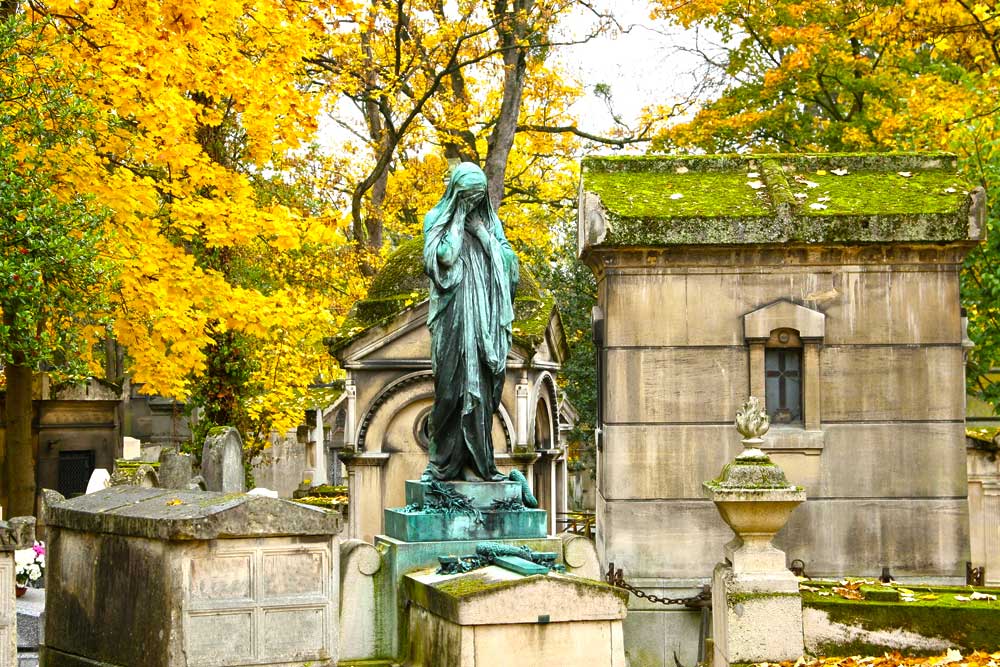
There’s no need to exaggerate to say that the Père-Lachaise cemetery in Paris is beautiful. Monuments, flowers, white walkways, incredible statues and countless memories will accompany you as you walk to discover the most important figures of France and beyond.
If you don’t know what to see in Paris on a gloomy day, the leaden clouds and light rain will convince you that the atmosphere is truly perfect to make the most of it. There’s no better time to venture among the tombs of this surreal place.
Despite being a cemetery, visiting Père-Lachaise will let you discover a wealth of beautiful monuments that have made it one of the most visited attractions in the city.
Why?
The beauty of some graves is truly impressive, as is the sweetness and delicacy of others. Walking through the narrow lanes of the Père-Lachaise cemetery, I discovered how a burial place has become a sort of city park: a place to walk in peace, where all kinds of statues peek out among mounds and mausoleums, and where photos, dates and portraits tell you moments of the lives of those who lived on this earth before us.
But enough with the preambles: below I’ll tell you about the 5+1 tombs to see in Père-Lachaise, all the practical information and some fun facts.
Want to know more?
Let’s go!

1 – The tomb of Géricault
As an art historian, I couldn’t write an article about the most beautiful tombs in Père-Lachaise without mentioning at least one of the greatest French artists.
You’ll surely remember Géricault for the Raft of the Medusa, now kept in the Louvre in Paris. And it’s precisely his most famous work that is depicted on one side of his funerary monument.
At the top there’s the statue of the artist, reclining with a colour palette in his hand, made by the sculptor Antoine Étex (1841). The realism is especially striking because Étex portrayed him as he was in his final years, marked by illness and by a bad fall from a horse.
On the sides of the monument, besides the Raft of the Medusa, you’ll find two more of his works: the Charging Chasseur and the Wounded Cuirassier.
Here’s a fun fact: Géricault’s tomb in Père-Lachaise was initially made of stone, then rebuilt in bronze about forty years later.

2 – The tomb of Abelard and Héloïse
Abelard and Héloïse are one of the most ill-fated couples in history. Before Tristan and Isolde, before Romeo and Juliet, there were they.
We’re in the 12th century: Abelard is one of the most influential theologians and philosophers of his time. He’s almost forty when he falls in love with one of his pupils, Héloïse, who is not only just seventeen but also from a noble family.
A violent passion breaks out between the two, leading to a child and to dishonour for both.
Forced to separate after a secret marriage, they exchanged love letters for years, letters that became famous, without ever being able to see each other again. They were reunited only after death, buried together.
At this point you might be thinking that the funerary monument of Abelard and Héloïse at Père-Lachaise is the original one. In reality, the current Neo-Gothic tomb was made only later, using stones from the Paraclete monastery, where Héloïse spent the last years of her life.
Here’s a fun fact! Abelard and Héloïse were among the first to be moved into the cemetery, in 1817, to attract Parisians to be buried here (but more on that later).

3 – The tomb of Oscar Wilde (1854-1900)
Oscar Wilde’s tomb is in division 89 of the Père-Lachaise cemetery. Not only is it one of the most visited, it’s also the one with the greatest number of anecdotes.
First of all, you should know that the writer wasn’t buried here straight away: his last friend took several years to find the sum needed to pay the concession, and until then Oscar Wilde’s body was kept in the Bagneux cemetery.
But what’s so special about Oscar Wilde’s tomb?
As in life, Wilde didn’t stop causing a stir even after his death.
The monument, an enormous block of stone, was sculpted by the artist Jacob Epstein and depicts a kind of flying winged sphinx, with its private parts rather on show. Although the work was completed in 1914, the “indecency” of the sculpture caused a scandal and, according to legend, the statue’s genitals were removed a few decades later.
But there’s another curiosity.
In recent decades, Oscar Wilde’s tomb has been the object of a strange custom, especially among female visitors, who began leaving lipstick kisses on the marble to symbolise their love for the artist.
Born as a lighthearted token of affection, the tradition soon degenerated into writing and drawings that risked seriously damaging the monument. Fortunately, in 2011, the City of Paris cleaned it all up and installed a glass barrier to protect the stone.

4 – Jim Morrison’s grave
Jim Morrison is one of the most emblematic figures of his era, and it shouldn’t surprise you that his grave is the most visited of the entire cemetery. Whatever time of day you decide to go to Père-Lachaise, you’ll surely find fans bringing him flowers.
Just think that, when he died at only 27, the cemetery director was persuaded to admit him only after reading some of his poems: Morrison was in fact buried here as a poet.

5 – The Wall of the Communards
The Wall of the Communards (Mur des Fédérés) at Père-Lachaise isn’t a monument dedicated to a single person, but has a story of its own.
This spot is sadly famous for a bloody event during the Paris Commune: on 28 May 1871, against the cemetery’s outer wall, 147 Communards were shot and then thrown into a mass grave.
Precisely because of this story, about a century later, the Wall of the Communards became the symbolic site of the French left’s demonstrations.
But not only: it’s a kind of pilgrimage destination for people of every ethnicity, creed or political faith, to assert the right to diversity and to remember the massacre of those years.
The statue of Victor Noir
Another very curious story concerns the statue of Victor Noir. His real name was Yvan Salmon, a young journalist. In 1870 he acted as a messenger to arrange a duel between Pierre Bonaparte and a friend of his, but he was shot dead in cold blood. Since the killer was a cousin of Emperor Napoleon III, he was not convicted and was soon acquitted.
The death of Victor Noir, at only 21 and on the eve of his wedding, became a symbol of opposition to the regime: more than a hundred thousand people attended his funeral, and the violent demonstrations that followed the acquittal contributed to the ruin of the already unpopular emperor. His body was moved to Père-Lachaise, where the sculptor Jules Dalou portrayed him in a life-size bronze statue, lying as he fell struck by the fatal bullet.
And here the story takes a more curious turn: the statue has a notable bulge between the legs. This feature made it famous in Paris and, according to popular belief, women gain greater fertility by rubbing that part of the statue and kissing its metal lips. So the death of this poor young man is now forever bound to the history of the cemetery.

Italians buried in Père-Lachaise
Did you know that many Italians are also buried in the Père-Lachaise cemetery?
If you’re planning a walk among these tombs, I suggest section 84, where you’ll find the memorial to the Garibaldians of the Argonne, dedicated to the Italian volunteers who fought for France in the First World War. Every year, on 11 November, a commemorative ceremony is held there.
The Italians buried within these walls are truly many, though of some only the cenotaph remains: that’s the case of the composer Gioachino Rossini and of Vincenzo Bellini, whose remains are now in Italy.
Among the artists, in section 96, you’ll find the tomb of Amedeo Modigliani, who rests beside his young companion Jeanne Hébuterne. Pregnant, she took her own life the day after the artist’s death, throwing herself from the fifth floor.

How to find the tombs in Père-Lachaise
Many famous people are buried in the Père-Lachaise cemetery.
Besides those I’ve already mentioned, some of the most important French artists and many leading figures from all over the world rest here: you can see the tombs of Géricault, Modigliani, Corot, De Nittis and Pissarro, among others.
But how can you find the funerary monuments of all these figures?
It’s very simple: at the entrance to the Père-Lachaise cemetery you can pick up a map showing the exact location of the most famous graves. If, for example, you’re looking for Oscar Wilde, the map will mark his division number so you can get there quickly.
Handy, isn’t it?
If instead you want a guided tour of Père-Lachaise, you can book a 2-hour small-group tour online: a guide takes you around the most important monuments and tells you the story of the place (tours are in English or French).
History of the Père-Lachaise cemetery
I don’t know if you’ve noticed, but “Père-Lachaise” in French means “Father La Chaise”: the name comes from the Jesuit Father François de la Chaise, confessor to Louis XIV, who owned the land on which the cemetery arose.
Another curiosity is that the Père-Lachaise cemetery was one of Paris’s first modern cemeteries, opened in 1804 in the Napoleonic era, designed by the architect Alexandre-Théodore Brongniart.
For what purpose?
The decision was driven mainly by reasons of public hygiene. Before this, the dead were buried in small cemeteries next to places of worship, or even inside churches, under the floor: it was believed that the closer the body was to a holy place or a relic, the sooner it would reach salvation.
Have you ever wondered why so much incense was used inside churches?
Perhaps it will surprise you that incense, in the past, served not only to cover the bad smell of the dead buried in churches but also to “disinfect” the air and prevent the spread of disease.
The tradition of being buried as close as possible to the saints was so deeply rooted that a clever ruse was needed to change things.
How did they do it?
With a well-orchestrated “advertising” campaign! To the Père-Lachaise cemetery the remains of famous figures who had died centuries earlier were transferred: in 1804 those of Molière and La Fontaine, and in 1817 those of Abelard and Héloïse, to convince Parisians to be buried outside the city walls. Areas were then created for the different religions, and the cemetery was enlarged several times, until it became a monumental cemetery like the Verano in Rome.
You may not believe it, but together with the Eiffel Tower, Notre-Dame and the Louvre, Père-Lachaise is one of the most visited attractions in Paris, with over three million visitors a year.

The numbers of the Père-Lachaise cemetery
Although there are other monumental cemeteries in almost every European capital, the Père-Lachaise is especially impressive for its size: it covers an area of 44 hectares and holds around 70,000 tombs.
For the artistic value of the monuments it holds, but above all for the importance of the figures who rest there, the cemetery of Paris is considered the most visited in the world.
But it wasn’t always this way!
In its early years, the Père-Lachaise cemetery was not well regarded by the inhabitants of Paris: just think that, ten years after it opened, only about 2,000 people had been buried here. It was precisely to overcome this reluctance that the authorities decided on the famous “relocation” of celebrities. The idea was so successful that by 1830 the cemetery’s “guests” already numbered more than 33,000.

How to get to Père-Lachaise, opening hours and useful info
To reach Père-Lachaise I suggest taking metro line 2 or 3 and getting off at the stop of the same name. The exact address is 16 rue du Repos, in the twentieth arrondissement, but it’s so large that you can’t miss it. Entry is free.
The hours vary by season. From 6 November to 15 March: Monday-Friday 8:00 am-5:30 pm, Saturday 8:30 am-5:30 pm, Sundays and public holidays 9:00 am-5:30 pm. From 16 March to 5 November: Monday-Friday 8:00 am-6:00 pm, Saturday 8:30 am-6:00 pm, Sundays and public holidays 9:00 am-6:00 pm. Bear in mind that clearing starts a quarter of an hour before closing and nobody is let in from that moment, and that an entrance can be shut: the Ménilmontant one was in August 2026, when I checked the hours and the accesses on the City of Paris page.
The cemetery is so vast that it’s worth getting a map (or relying on a guide). If you’d rather find your way among the tombs without wasting time, the 2-hour guided tour is a good way not to miss the most beautiful monuments and their stories.
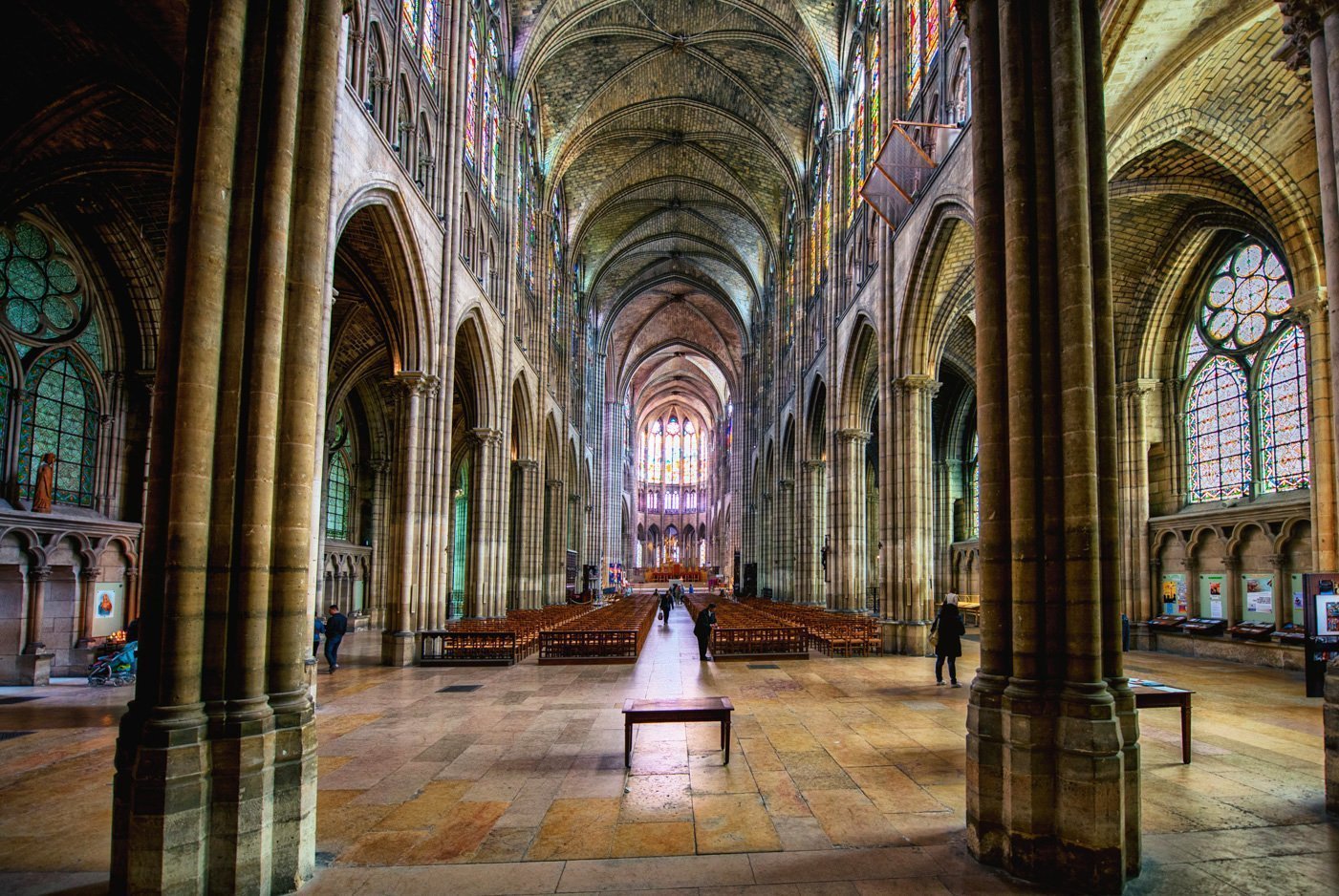
And if you enjoyed this unusual Paris? Take a look at the royal necropolis of the Basilica of Saint-Denis and at bohemian Montmartre.