Would you like to visit Paris and discover something unusual outside its historic centre? The Basilica of Saint-Denis is exactly what you’re looking for!
This beautiful building is little known to tourists and certainly far less crowded than the famous Notre-Dame, but it’s hugely important both historically and architecturally.
The church is tied by a double thread to the French monarchy.
As you stroll through its aisles, you can’t help but notice that, inside the Basilica of Saint-Denis, some seventy funerary monuments of the greatest sovereigns of France are preserved. Among them you’ll even find the tombs of Catherine de’ Medici and Louis XVI.
But there’s more!
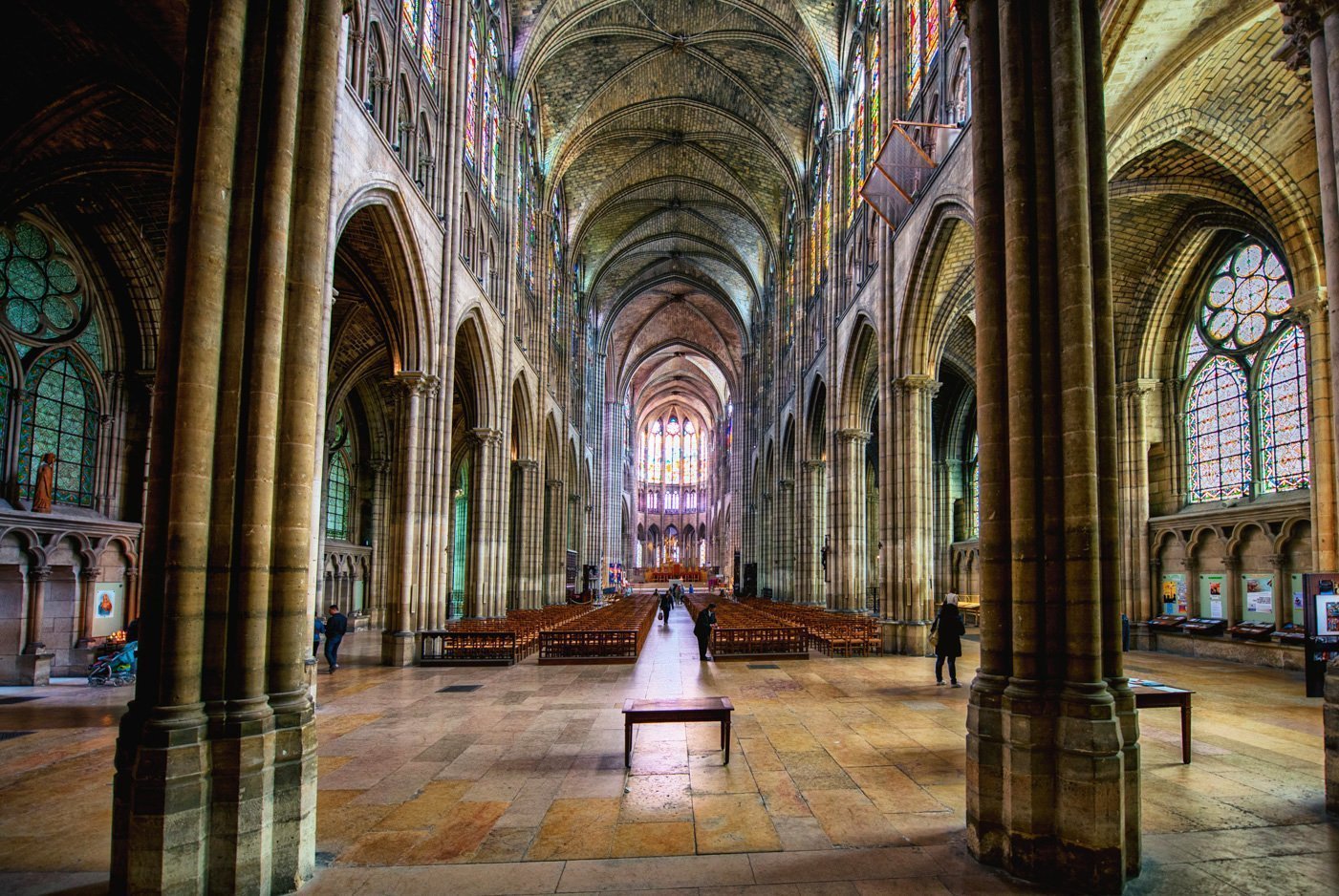
Besides being important for the history of France, the Basilica of Saint-Denis is hugely significant for its architectural style too: the building marks the transition from Romanesque to Gothic art and is considered the first great work built in this new language.
Are you ready to visit Paris off the usual tourist trails?
Let’s go!
Saint-Denis: the story of the first Gothic church in France
The Basilica of Saint-Denis in Paris is one of the earliest examples of Gothic architecture.
But how does it differ from earlier buildings?
If you’ve already visited Romanesque cathedrals like the one in Trani or in Ruvo, you’ll easily realise that the differences with the Basilica of Saint-Denis are enormous.
Unlike the massive Romanesque style, the Gothic one is far more slender and “light”. Among its main features you’ll immediately notice the great windowed walls, a completely different use of light and the vertical thrust.
But why was the first Gothic church in France built right here?
The site wasn’t chosen by chance. The church rose on the burial place of Saint Denis, first bishop of Paris. Legend has it that the saint was beheaded on Montmartre and walked, with his head in his hands, to the spot where the church stands today.
When the saint died, a small shrine was immediately built, which over the years became a place of numerous pilgrimages. This is why, around 630, King Dagobert I decided to enlarge it and to found an abbey there.
The turning point, however, came in the 12th century with Abbot Suger, who between 1135 and 1144 had the façade and above all the new choir rebuilt: consecrated on 11 June 1144, it’s considered the first fully Gothic space in history. It was Suger himself who recounted the undertaking in his treatises (the De consecratione and the De administratione), explaining his choices of light, sumptuous furnishings and the magnificent choir.
A detail you may not know: for centuries Saint-Denis was an abbey, not a cathedral. It became a cathedral only in 1966, with the creation of the Diocese of Saint-Denis.
In short, Suger was a true innovator!

The completion of the Basilica of Saint-Denis
Sadly, the brilliant Abbot Suger never saw the Basilica of Saint-Denis completed.
The nave and the upper part of the choir were in fact rebuilt much later, in the 13th century under Louis IX, in the “Rayonnant” Gothic style; the direction of the works is traditionally linked to Pierre de Montreuil, the same architect as the Sainte-Chapelle in Paris. The design included a very wide transept, suited to housing the tombs of the kings of France, bound to this sacred place from the very beginning.
A little curiosity: do you know why the façade is asymmetrical?
No, it wasn’t a design error. The façade is missing its north tower with its spire (90 metres tall), struck by lightning in 1837 and then weakened by a series of violent storms: it was therefore dismantled between 1846 and 1847. Since then the basilica has had a single tower.
Some good news: after almost 180 years, on 14 March 2025 the foundation stone was laid to rebuild the north tower and spire, in a project that will last several years. If you go now, you might see Saint-Denis becoming whole again.

Saint-Denis: the necropolis of the French sovereigns
Dagobert I not only transformed the small shrine of Saint-Denis, but was also the first king of France to be buried here, around 639. After him, for over a thousand years, almost all the French sovereigns wanted to rest here: the basilica today holds the tombs of around 43 kings and 32 queens.
Do you want to know who the most important kings you can meet at Saint-Denis are?
The ancient stones of the church preserve the remains of sovereigns of every dynasty: from the Carolingians like Charles Martel, Pepin the Short and Charles the Bald, to the Capetians, right up to the Bourbons (these last without a proper monument: their embalmed bodies were placed in the crypt).
There are exceptions, of course: Louis XI, for example, chose to be buried at Notre-Dame de Cléry, while of Saint Louis IX, who died in Tunis in 1270, very little remains, because his tomb was destroyed.
And the most beautiful tombs?
I found the funerary monument of Louis XII and Anne of Brittany very striking: the sculptures have a powerful symbolism, because the sovereigns’ bodies are depicted below as transi, that is corpses, while above we see them risen and in prayer.
The finest sculptures, however, are those of Louis XVI and Marie-Antoinette: you can admire them, gathered in prayer, in one of the basilica’s chapels.

Saint-Denis during the French Revolution
Sadly, the French Revolution led to the loss of much of the original furnishings, tombs and decoration. In 1793 the revolutionaries desecrated the necropolis, a symbol of the monarchy: they opened the tombs (also to recover the lead from the coffins, to be melted into ammunition) and threw the kings’ remains into two large common pits, covered in quicklime.
Many tombs were heavily damaged. The royal remains were recovered and gathered together only later: it was Louis XVIII, in 1817, who had them searched for and collected in an ossuary in the crypt, where you can still read the long list of the sovereigns of Saint-Denis.
The basilica was then restored in the 19th century, first by François Debret and then by Viollet-le-Duc, the same man who would design the famous spire of Notre-Dame in Paris, destroyed in the fire of 15 April 2019. During the restoration, as much as possible of the ancient funerary monuments was recovered, and they can be seen today along the route around the apse.
As for the surviving sacred objects, you can still admire them between the Musée de Cluny and the Louvre in Paris.

How to visit Saint-Denis today
Saint-Denis was tied to the life of the French sovereigns as much as Reims, the city of coronations, and for this reason it has a very special value. Take your time to contemplate the magnificent architecture and the small sculptures of the capitals in the crypt.
I was truly astonished by this place, and what struck me most is the overall vision of the evolution of art across the centuries. As at Père-Lachaise, here you retrace history from an unusual point of view, unique in the world.
Practical information for visiting Saint-Denis
Tickets. The basilica is managed by the Centre des monuments nationaux. Since the Fabrique de la flèche opened, the working museum of the spire being rebuilt, the Tuesday-to-Sunday ticket covers necropolis and Fabrique together and costs €17 (reduced €14). On Mondays, when the Fabrique is closed, you enter the royal necropolis alone for €11 (reduced €9.50), fares checked in August 2026; it’s free for under-18s and for 18-25 year-olds resident in the European Union (you’ll still need to go to the ticket desk and show ID). There’s also a combined ticket with the Panthéon in Paris (€16).
At the ticket desks, outside the basilica, there’s usually a fair queue, both to buy tickets and for the security checks. My advice is to buy the skip-the-line ticket online, so your visit is much quicker and worry-free.
Something new: since 2025, next to the necropolis, La Fabrique de la Flèche has opened, a space dedicated to the spire’s reconstruction site, which you can visit with a combined ticket.
How to get there. Reaching Saint-Denis from Paris is very easy: it’s connected directly by metro line 13, Basilique de Saint-Denis stop. By car, the address is 1 rue de la Légion d’honneur, 93200 Saint-Denis, with a car park about a hundred metres away.
Opening hours. They change with the seasons: from 1 April to 30 September, Monday-Saturday 10:00-18:15 and Sunday 12:00-18:15; from 1 October to 31 March, Monday-Saturday 10:00-17:15 and Sunday 12:00-17:15 (closed on 1 January, 1 May and 25 December). Arrive at least an hour before closing, as the ticket desks close about 45 minutes earlier.
And if you still have time in Paris? Don’t miss the Sainte-Chapelle, the luminous sister of Saint-Denis, and the reborn cathedral of Notre-Dame.