Are you in the French capital and dreaming of a cultural tour of Paris? You have probably noticed that visiting the Louvre or the Musée d’Orsay takes a lot of time and energy. These are two of the most important museums in Paris, and thousands of people walk through them every single day.
Visiting the Louvre can even become an exhausting experience: not only will you never see it all in a single day, but walking past all those wonderful works can give you a splitting headache or even a touch of Stendhal syndrome. If you feel like something smaller and easier to explore, here is my tip.
To help you choose a Paris museum that is both beautiful and easy to discover, I went to visit the Petit Palais in Paris.
Why?
The Petit Palais in Paris is one of the most underrated museums in the French capital. It sits inside one of the loveliest buildings raised for the 1900 World’s Fair, and today it houses the city’s fine arts museum, with works spanning from antiquity to the twentieth century.
Want to know the best part?
Not only is it far less crowded than the Louvre, but admission to the permanent collection of the Petit Palais is completely free: that is why I put it among the artworks to see in Paris, where four of the nine stops cost nothing.
Have I sparked your curiosity?
Good, then let me tell you about my visit, the works of the Petit Palais in Paris and a discovery that made me fall head over heels.
Let’s go!
The story of the Petit Palais and its architecture
The Petit Palais in Paris, literally “small palace”, was built facing the Grand Palais as an exhibition space for the 1900 World’s Fair. Work began in 1897 and was completed in early 1900, to a design by the architect Charles Girault. In 1902 the building became the fine arts museum of the city of Paris (Musée des Beaux-Arts de la Ville de Paris), which it still is today.
Do not let the name fool you: there is very little that is “petit” about it. It is called that only because it plays second fiddle to the far grander Grand Palais standing right across from it.
Want to know its style?
The façade is a beautiful example of Beaux-Arts architecture, the eclectic, monumental style so fashionable at the end of the nineteenth century. Girault drew on the French style of the seventeenth and eighteenth centuries, with references to the stables of the Château de Chantilly: a central porch crowned by a gilded dome that echoes the nearby Invalides, and a triple-arched entrance. The famous wrought-iron gates, on the other hand, have an elegant Art Nouveau flair.
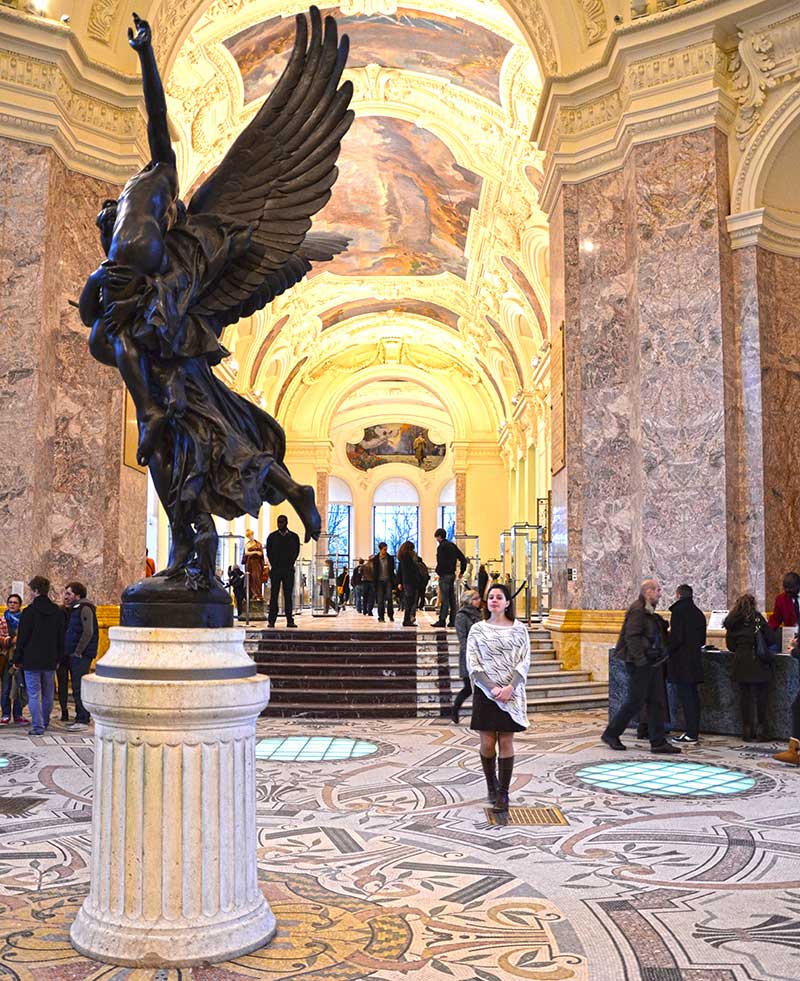
The building has a trapezoidal plan and hides a treasure at its heart that few people expect: a semicircular garden ringed by a colonnade, with exotic plants and a small café where you can stop and rest. In spring and summer it is a truly enchanting corner.
A little curiosity: the building itself is worth your attention, but I promise you the real treasure is the collection kept inside.
Let me tell you about it now.
The works of the Petit Palais in Paris: here is what I loved most
The permanent collection of the Petit Palais in Paris will leave you speechless.
The museum route runs through the historical eras and the techniques artists explored from antiquity to the twentieth century. There are Greek and Roman finds, liturgical objects and medieval and Renaissance masterpieces (many from the rich Dutuit collection), large-format canvases, graphic arts, jewellery and objects of everyday life.
You would not normally expect famous artists in these “minor” museums, yet at the Petit Palais you will discover genuine masterpieces from wildly different periods.
For example?
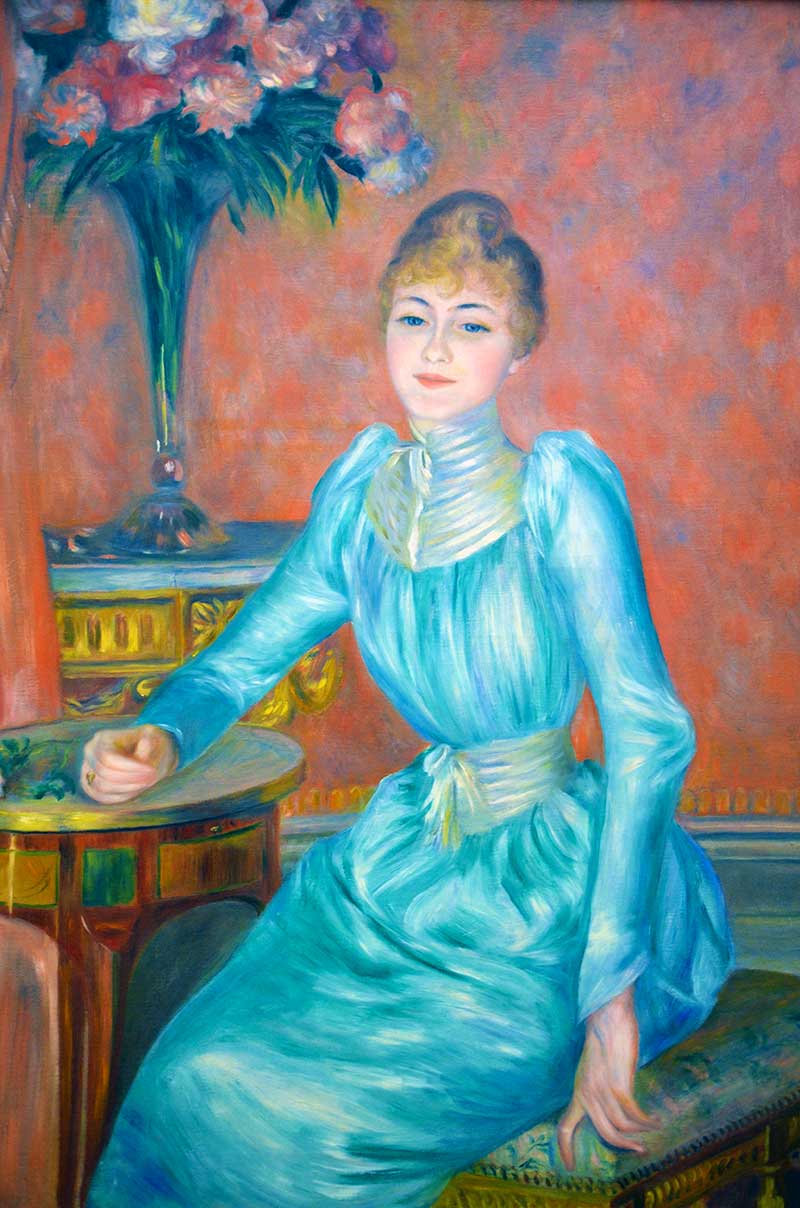
Among the finest paintings are great masters such as Rembrandt and Rubens, and then Delacroix, Courbet, Cézanne and Monet: there is even a lovely section devoted to the Impressionists. I also greatly enjoyed the “minor arts” collections, the small antique objects, the figurines, the clocks and the tableware.
But the canvas that struck me most is Grimaces et misère - Les Saltimbanques by Fernand Pelez, a huge painting from 1888, more than six metres long, showing a life-size row of circus performers, clowns and musicians worn out by fatigue. I had never seen it in person, and its rawness and realism left me stunned.
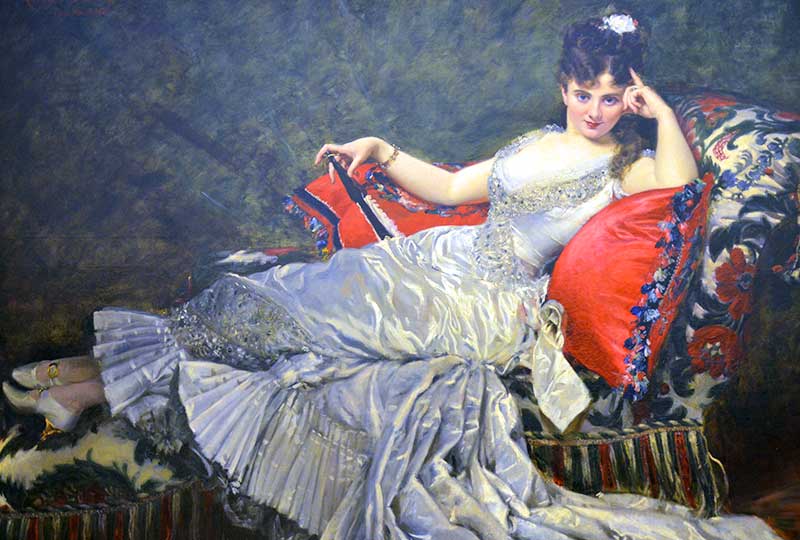
Still, as I told you at the start, at the Petit Palais I made a wonderful discovery: a canvas I fell utterly in love with, the Femme aux gants by Charles-Alexandre Giron, better known as La Parisienne.
A little curiosity: Giron painted this elegant lady in long gloves in 1883 and affectionately nicknamed her the “Black Diamond”. The painter, of Swiss origin, always kept the work close to him, and it was his daughter who donated it to the museum in the 1960s.

Temporary exhibitions at the Petit Palais
The temporary exhibitions at the Petit Palais are very well put together. I have had the chance to see more than one, and the displays are always beautifully done. Once I found myself at an exhibition on Jordaens, a seventeenth-century Flemish painter I knew almost nothing about and who, in the end, did not stir any particular emotion in me.
Has that ever happened to you?
Even though I adore the Flemish painters, I did not find his works especially beautiful, except for a couple of canvases. But I have to say the route was superbly organised and the works on show were plentiful. If you too love the masters of the North, do not forget to read about my trip to Flanders.
One important thing to keep in mind: while the permanent collection is free, the temporary exhibitions are paid (usually around 15 to 17 euros). They generally range from painting to photography, and you never know what little wonder you might find there.
Practical information
The fastest way to reach the Petit Palais is to take metro line 1 or 13 and get off at Champs-Élysées – Clemenceau: you will come out right in front of it. Alternatively there is line 9, Franklin D. Roosevelt stop. The address is avenue Winston Churchill, in the 8th arrondissement, a stone’s throw from the Champs-Élysées and Place de la Concorde.
The museum is open from Tuesday to Sunday, 10 a.m. to 6 p.m. (the galleries close at 5.45 p.m.). On Friday and Saturday there is a late opening until 8 p.m., but only for the temporary exhibitions. It is closed on Mondays and on public holidays (1 January, 1 May, 14 July, 25 December).
Remember that admission to the permanent collection is completely free and no booking is required: a rare treat in a city where the big museums are pricey and come with endless queues.
Narrowing down the museums to see in Paris in a short time is genuinely hard, but if you stay a few extra days, do not forget to devote a few hours to this Petit Palais, which is “petit” in name only. And to keep discovering the city, I am waiting for you in my guides to the Sainte-Chapelle and to what to see in Montmartre.
If you like the idea that the decorative arts are art in their own right, elsewhere I explain why Cartier’s jewels are true works of art.