The Capitoline Museums are among the most beautiful museums in Rome. Their collections include ancient statuary, a picture gallery and archaeological remains of priceless value and beauty.
They are, without a doubt, among my favourite museums in Rome, together with the Vatican Museums and the Palazzo Massimo Museum, near Termini station.
But the Capitoline Museums have a charm all their own: maybe it’s their position at the top of the Capitoline Hill, or the fact that they stand where one of the most important pagan temples of ancient Rome once rose. Either way, I’m sure you’ll fall in love with them.
If you want to visit the Capitoline Museums, get ready to be amazed. The museum unfolds across two historic buildings, Palazzo Nuovo and Palazzo dei Conservatori, whose façades, along with the square they face, were designed by Michelangelo Buonarroti.
Inside, the rooms are sumptuous and are still used today for special institutional visits; not far away stands the office of the Mayor of Rome. The Capitoline Hill has always been the centre of the city’s power: it’s no coincidence that the English word for a government building is Capitol, in French Capitole and in Spanish Capitolio.
Did you know the Capitoline Museums are considered the oldest in the world?
Just think: the first collection of ancient bronzes was donated in 1471 by Pope Sixtus IV to the people of Rome. The masterpieces of antiquity finally became visible to everyone and were imitated and quoted throughout the Renaissance (the museums proper opened to the public later, in 1734).
After the Vatican Museums, the Capitoline Museums are among the most visited in Rome: that’s why it’s worth buying your skip-the-line ticket online, so you skip the queue at the ticket office and save precious time for the Eternal City.
But enough with the preambles: here are the 8 works of the Capitoline Museums you absolutely must know.
Fancy learning a little more?
Let’s go!
1 – The Capitoline She-Wolf, Romulus and Remus
The Capitoline She-Wolf has been the symbol of Rome for centuries. Visiting the Capitoline Museums without stopping to admire her is like going to Paris and forgetting to climb the Eiffel Tower.
Do you know her legend?
The story goes that the vestal Rhea Silvia, daughter of a king dethroned by his own brother, bore twins to Mars, the god of war. The usurping uncle ordered the children killed, fearing they would one day overthrow him in turn. But the servant charged with drowning them took pity and abandoned them in a basket on the river Tiber.
Miraculously, the basket ran aground in a bend of the river. There a she-wolf found the two newborns and suckled them for days, until a shepherd noticed them and took them home. Those two children were Romulus and Remus, the mythical founder of Rome and his brother.
But beyond the legend of the city’s foundation, the Capitoline She-Wolf makes people talk for another reason too.
She was part of the first donation of Sixtus IV in 1471 (she reached the Capitol from the Lateran) and is therefore one of the museum’s emblematic works. It is now certain that the two twins were added only in the Renaissance, probably by Antonio del Pollaiolo.
A curiosity: for centuries the wolf was believed to be an Etruscan bronze of the 5th century BC. But the technical analyses carried out during the restoration between 1997 and 2000 (by the restorer Anna Maria Carruba) moved the dating to the Middle Ages, perhaps the 11th-13th century: the statue is cast in a single piece, something the Etruscans did not do. The theory is still much debated, but it has shaken one of Rome’s oldest certainties. Whatever her age, her symbolic power remains intact: the brute strength of a wild beast tamed by love, to the point of giving her milk to two helpless newborns.

2 – The colossal statue of Constantine
In Rome they call them er piedone, er capoccione and er ditone (“the big foot”, “the big head”, “the big finger”). Few of those who visit the Capitoline Museums really know the story of these huge marble fragments: they are the remains of the colossal statue of Constantine.
The original stood in the Basilica of Maxentius, in the Roman Forum: the remains of that imposing building are still visible near the Colosseum. It was right there that the emperor Constantine had his gigantic statue placed, over ten metres tall, to celebrate his victory at the Battle of the Milvian Bridge (312 AD).
It was an acrolithic work: the exposed parts of the body, that is the head, hands and feet you see in the courtyard of Palazzo dei Conservatori, were of marble, while the rest, the great torso, was a structure of wood and brick, perhaps covered with gilded bronze.
From the colossal head, the fixed and almost absent gaze of the first emperor to grant freedom to Christianity stares back at us. It is with him that the transformation of the artistic language begins, the slow passage from “classical” art to “medieval” art. Times change and, as always, so do the ways of art.

3 – The statue of Charles I of Anjou by Arnolfo di Cambio
The statue of Charles I of Anjou at the Capitoline Museums is a medieval work, carved in marble by Arnolfo di Cambio around 1277. It came from the nearby Palazzo Senatorio, where Charles had served as Senator of Rome, and it matters because it is considered the first sculpted portrait of a living person since antiquity.
Before then there had been only sporadic attempts to reproduce the features of real people, almost always on funerary monuments. Here, instead, we have a life-size portrait of a flesh-and-blood ruler. If you look closely at the face, you’ll even notice the furrows of the wrinkles: the sign that something, in the language of art, was changing once again.
A detail you may not know: the statue was carved from a fragment of the entablature of an ancient Roman building and was originally painted in bright colours and enriched with gilding. Just as the head of Constantine marked the passage from classical to medieval art, the head of Charles I of Anjou marks the return to portraiture and the approach of the Renaissance.

4 – The Spinario (Boy with Thorn)
Like the Capitoline She-Wolf, the bronze Spinario at the Capitoline Museums was part of the collection donated by Sixtus IV. At first glance it is a simple sculpture, almost humble in its subject: a young man seated, legs crossed and head bowed, in the act of pulling a thorn from his foot.
In reality it is a highly refined and somewhat “hybrid” work. The body follows Hellenistic models, but the head is in an archaising style, inspired by Greek sculpture of the 5th century BC: an eclectic combination that scholars date probably to the 1st century BC. Analyses have shown that head and body were cast separately, with different alloys, in the Latium region.
But why is it so important?
Because the Spinario was one of the most imitated statues of the Renaissance. You find it in countless 15th-century paintings and frescoes, and even in the famous panel with which Brunelleschi took part, in 1401, in the competition for the door of the Florence Baptistery.

5 – The Fortune Teller by Caravaggio
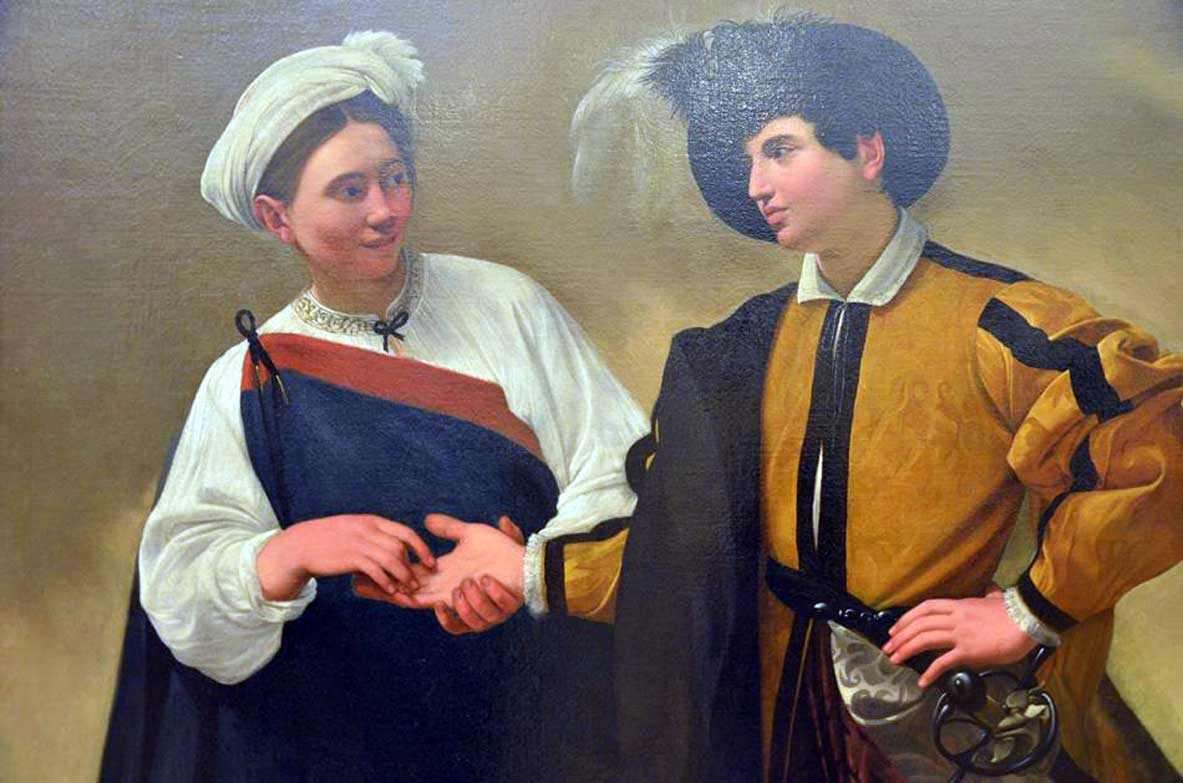
Among the works of the Capitoline Museums there are also two masterpieces by Caravaggio, kept in the picture gallery: The Fortune Teller and the Saint John the Baptist (a smiling youth embracing a ram). Let’s pause on the first.
The Fortune Teller shows a wealthy young man and a gypsy woman foretelling his future. She distracts him with her sly gaze while, on the pretext of reading his palm, she slips the ring off his finger. Caravaggio painted the canvas very young, between 1593 and 1595, when he frequented the workshop of the Cavalier d’Arpino: scholars consider it the prototype of all later versions of this subject.
The scene is a slice of everyday life, hardly theatrical yet intense: with just a few elements Caravaggio conveys the character of the two figures. The young man is relaxed, hand on his hip, his face full and a little naive, wrapped in precious fabrics. The girl, by contrast, has lively eyes and a cunning smile. And if you look closely at her nails, you’ll notice they are dirty.
A curiosity: an X-ray taken in 1977 revealed that Caravaggio painted The Fortune Teller on an already-used canvas: beneath his painting hides a work by the Cavalier d’Arpino. The master had evidently let him reuse an old workshop canvas.
According to the biographer Bellori, Caravaggio chose as his model a real gypsy woman he had met in the street, to prove that great painting can start even from humble subjects. That was his way of working: to take ordinary people and make them eternal.
6 – The equestrian statue of Marcus Aurelius
The equestrian statue of Marcus Aurelius at the Capitoline Museums is hugely important: it is the only large bronze equestrian statue from antiquity to reach us intact. History remembers Marcus Aurelius as one of Rome’s finest emperors, the philosopher emperor, and everything in this work conveys balance: balanced is the horse, balanced are his gestures.
The monument was made around 176 AD. But if it has survived almost two thousand years, there is a very precise reason.
Do you know why it was never melted down?
In the Middle Ages most bronze statues were melted to recover the metal: recasting an “old statue” cost far less than mining new bronze. The statue of Marcus Aurelius, however, was believed to be a portrait of Constantine, the first emperor favourable to Christians, and precisely because of this “mistaken identity” it was spared. Documented at the Lateran since the Middle Ages, it was later brought to the Capitol and placed by Michelangelo at the centre of the square, in 1538.
It stayed there until 1981, when acid rain and pollution were by then threatening its survival: the statue was removed and restored. In 1997 a faithful copy took its place at the centre of the square (the one you still see today), while since 2005 the original has been displayed in the glazed exedra designed by the architect Carlo Aymonino, where natural light illuminates it, changing with every hour of the day.
It’s a real spectacle.

7 – The Dying Gaul
The Dying Gaul is one of those works of the Capitoline Museums that moves me every time I see it again.
It is a Roman marble copy of a bronze original, made around 220 BC, perhaps by the sculptor Epigonus. It was part of the offering that King Attalus I dedicated to the city of Pergamon to celebrate his victory over the Galatians, the Celtic tribe that threatened his kingdom. The warrior, in fact, wears a torque around his neck, the typical Celtic ornament.
Together with the Ludovisi Gaul (today at Palazzo Altemps), the Dying Gaul tells a moment of great intensity. The warrior, wounded in the side, slowly collapses to the ground. His strong, naked body is tense with pain and with the awareness of defeat, his face contracted, his weapons scattered, blood pouring from the wound. He is a young man who understands he is about to die and seems to reflect, for one endless instant, on the fragility of life.

8 – The head of Medusa by Bernini
The head of Medusa at the Capitoline Museums is a work attributed to Bernini, though the attribution has not yet been fully proven. Beyond this little “mystery”, the quality of the marble is undeniable.
The gorgon, the terrible monster with snakes instead of hair, is portrayed at the very instant she turns to stone. You should know that Medusa petrified anyone who met her gaze, until the hero Perseus defeated her with a trick: he showed her her own reflection in a polished shield, and the gorgon was petrified by her own eyes.
Bernini captures that very moment in marble: Medusa looks at herself in an imaginary mirror, and in her eyes there is all the anguish of having been outwitted. The scene is rendered so vividly that it seems to be happening right in front of you. The power of this small bust is incredible; and if you’d like to see Bernini’s other works, I recommend a visit to the Galleria Borghese.

Practical information for visiting the Capitoline Museums
To visit the Capitoline Museums, set aside at least three hours. Take your time to enjoy the classical statuary, from Etruscan-Republican Rome to the late Empire, to daydream a little in the picture gallery among the works of Baroque Rome, and to lose yourself contemplating the view of the Forum from the Tabularium.
Don’t miss the majesty of the ancient Temple of Jupiter Capitolinus, whose foundations lie inside the glazed exedra of Marcus Aurelius, designed by Carlo Aymonino and opened to the public in 2005. And look, among the rooms, for other masterpieces well worth it: the delicate Capitoline Venus, the famous mosaic of the doves and the Commodus as Hercules.
A few practical tips. The ticket office and the entrance are next to each other, but with two separate queues: first buy the ticket, then line up for the security check (you go through a metal detector, so get ready in advance). Don’t bring penknives or sharp objects, as they are not allowed.
The museum is open every day from 9.30am to 7.30pm (last entry at 6.30pm). The full ticket for non-residents costs 15 euros, the reduced one 9.50 euros. Careful, though, because that is the base rate: it goes up when exhibitions are on, and in August 2026 the ticket is 20.50 euros (reduced 15) because of the Diego Rivera show, running until 6 September (checked in August 2026). Residents of Rome and its metropolitan area get in free with an ID (prices rise when temporary exhibitions are on). Remember that on the first Sunday of the month admission is free for everyone; and since February 2026 it is also free for residents of Rome and its Metropolitan City, on showing an ID at the desk. During the busiest periods it’s still worth booking your ticket online so you don’t get stuck in the queue.
Enjoy your visit! And if you want to keep exploring the masterpieces of Rome, I’ll be waiting for you in my guide to the Vatican Museums and in the selection of the eight museums in Rome that really are worth the ticket.