
Want to know the curiosities and anecdotes about Michelangelo’s Sistine Chapel?
You are in the right place.
I have walked in more than a few times, and I still get the same lump in my throat when I look up at that ceiling. In this article I will tell you about Michelangelo and his work inside the Sistine Chapel: the man behind the artist, the technical blunders, the painted revenge and the details that will make you look at it with new eyes.
One thing to keep in mind before anything else: Buonarroti did not want this commission at all. He was a sculptor, and until then he had barely touched the technique of fresco. To paint the Sistine Chapel ceiling, curved on top of everything, he had to learn from scratch a craft that was not his own.
Remember one important thing: the Sistine Chapel can only be visited through the Vatican Museums, and it is almost always the last stop on the route. To avoid the endless line at the ticket office I recommend the guided tour of the Vatican Museums and the Sistine Chapel, with skip-the-line entry.
Are you ready to discover the curiosities of one of the most beautiful places in Rome?
Let’s go!
The Sistine Chapel before Michelangelo
You may not know it, but when Michelangelo arrived with his brushes, the Sistine Chapel had already existed for more than thirty years.
It was built for Pope Sixtus IV della Rovere between 1473 and 1481, and it is named after him (it was originally called the Cappella Magna). The lower walls, the ones people often glance past, were frescoed by an extraordinary team of artists: Botticelli, Perugino, Ghirlandaio, Signorelli, Rosselli and Pinturicchio. These are the cycles with the stories of Moses and Christ, and they deserve the same attention as the ceiling.
Here is a detail few people know.
According to a widespread tradition, the proportions of the chapel (about 40 metres long, 13 wide and nearly 21 high) echo those of the Temple of Solomon described in the Bible. It is a fascinating idea, but take it for what it is: a suggestive symbolic reading, not a fact proven by the building records.
A curious fact: it is right here, beneath Michelangelo’s ceiling, that the cardinals still gather in conclave to elect a new pope. When the doors close, those are the walls surrounding them.
The personality of Michelangelo Buonarroti
The curiosities about the Sistine Chapel are tightly bound to the character of the man who painted it.
Michelangelo Buonarroti was a difficult and eccentric person. We know about his irascible temper thanks to Vasari, the first “art historian” ante litteram and a great admirer of his. Despite the wealth he accumulated through his commissions, it is said that he lived almost on the edge, isolated and tormented.
Many link his inner suffering to the fact that Michelangelo was homosexual. At the time homosexuality was considered a mortal sin, and he, a deeply devout Catholic, remained obsessed by it all his life, together with the thought of death and the salvation of his soul.
How do we know all this?
Little known are Michelangelo’s poems, yet it is there that the artist confides his turmoil over the love for a man, in conflict with his faith.
There is also an anecdote about his neglected appearance. It is said that the other artists at the papal court mocked him for his bad temper and lack of personal care, so much so that Raphael, his rival, is thought to have portrayed him as the solitary philosopher Heraclitus in “The School of Athens”, wearing the worn-out boots that, they say, he never took off.
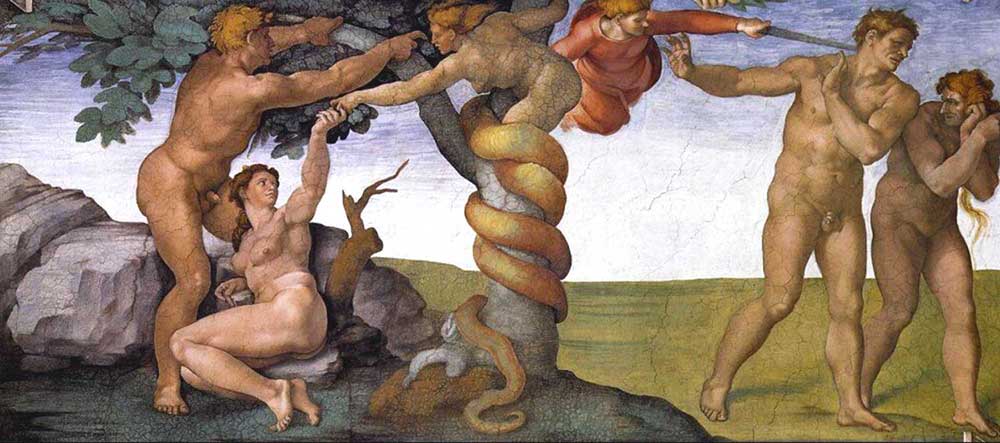
1 – Bramante’s plan and the impossible scaffolding
You may not have known it, but Michelangelo did not love painting: he far preferred sculpture, the art in which he truly excelled.
So why did he end up painting the Sistine Chapel ceiling?
According to Vasari’s account, it was Bramante who suggested to Pope Julius II that he give the commission to Michelangelo, hoping he would fail at a craft that was not his own, and thus favouring his friend Raphael. Let me say it honestly: this version is Vasari’s testimony, not a documented fact, and historians treat it mostly as gossip (Michelangelo, after all, had trained in the workshop of Ghirlandaio, a master of fresco).
True or exaggerated as the story may be, one episode remains telling. To reach the ceiling, nearly 21 metres high, a solid scaffold was needed. Bramante proposed hanging it from the vault with ropes, piercing the ceiling. When asked how the holes would then be covered once the work was done, he answered that he would think about it later.
Here is something not everyone knows.
Michelangelo, having realised that “either Bramante was worth little in this, or he was no friend of his”, designed a system of his own: a wooden structure resting on brackets projecting from the walls, which did not touch the floor and did not pierce the vault. It worked so well that it was used again afterwards.
A curious fact: precisely because he worked up there standing with his head bent back, Michelangelo ruined his eyesight and his back, and he told the story himself in a sonnet full of bitter irony.
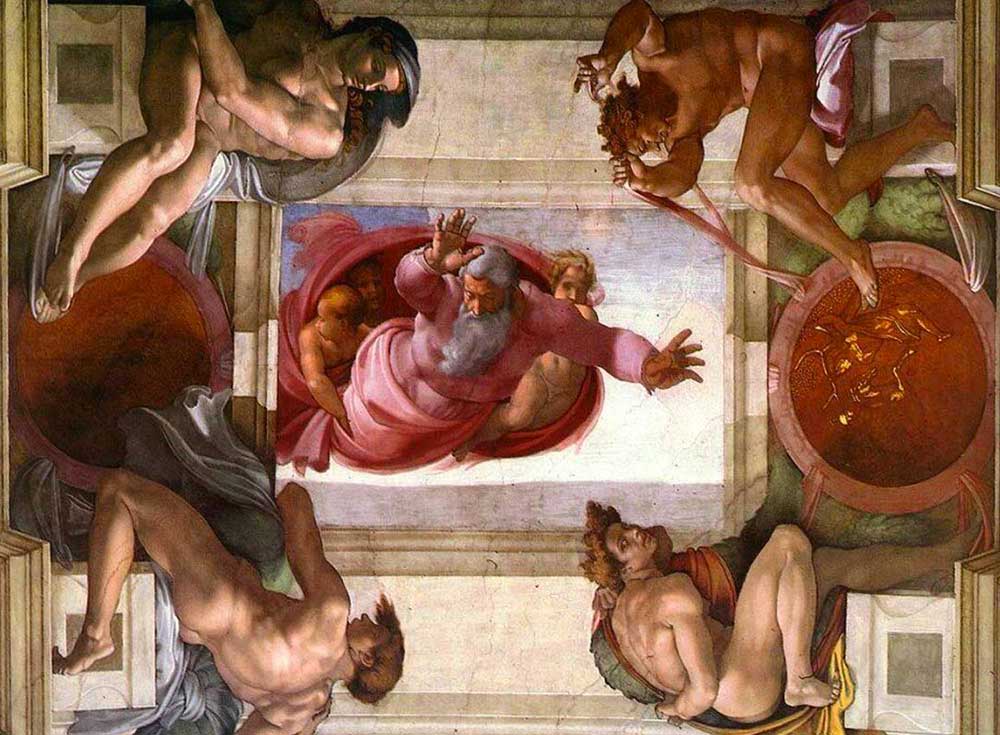
2 – The mould on the plaster: the first disaster
Once the scaffolding problem was solved, Michelangelo had to face an invisible enemy: the plaster.
Instead of relying on the traditional Florentine mix of lime and sand, he wanted to experiment with a blend containing pozzolana, a material of volcanic origin. The first attempts were a disaster: he got the proportions wrong and part of the work quickly began to grow mould.
Can you imagine his discouragement?
Luckily he did not give up. With the help of his assistant Jacopo, nicknamed “l’Indaco”, he adjusted the recipe and found the right proportions, making the Sistine Chapel fresco not only one of the most beautiful in the history of art, but also one of the most technically sound.
A curious fact: it is the same care for the material that Michelangelo poured into marble. If you want to fully understand this obsession with perfection, I recommend reading about the life and works of Michelangelo.
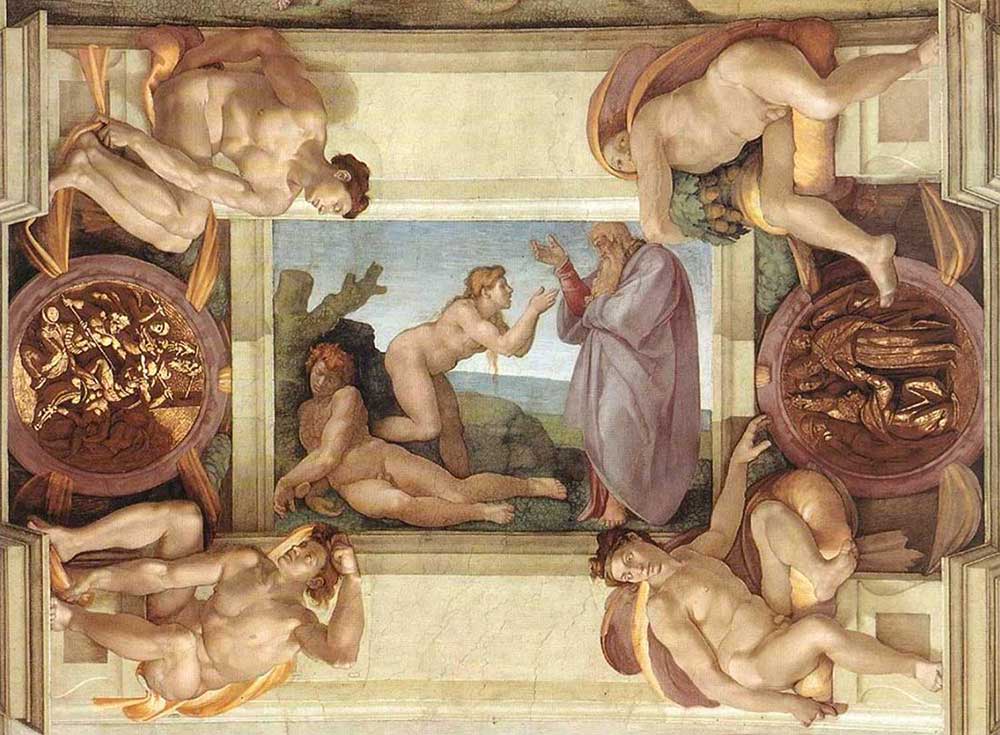
3 – Michelangelo did not paint lying down (nor in company)
There is one image everyone has in mind: Michelangelo stretched out on the scaffolding, painting the ceiling flat on his back.
What if I told you it is a legend?
He actually worked standing up, on his scaffolding, with his neck bent back and his arms raised for hours. An enormous strain, which has nothing to do with the comfortable lying-down pose of the myth.
The story of the artist who painted everything alone also needs some perspective. At first Michelangelo had a team of Florentine assistants beside him, but he judged them inadequate and sent them away. He kept using collaborators, though, for the heavier tasks (grinding colours, laying the plaster, transferring the cartoons). The artistic part, the figures, he did himself: which is a huge amount, but it is not true that he did absolutely everything in total solitude.
And the pope?
It is said that Julius II, extremely curious, kept insisting on seeing the work in progress. Exasperated, Michelangelo pretended to leave for Florence, only to be caught by the pope who, having sneaked in, found him still shut inside, painting.
A curious fact: the ceiling was unveiled on 31 October 1512, after about four years of work. The next day, for the feast of All Saints, the pope celebrated the first mass there. Michelangelo still considered it imperfect.
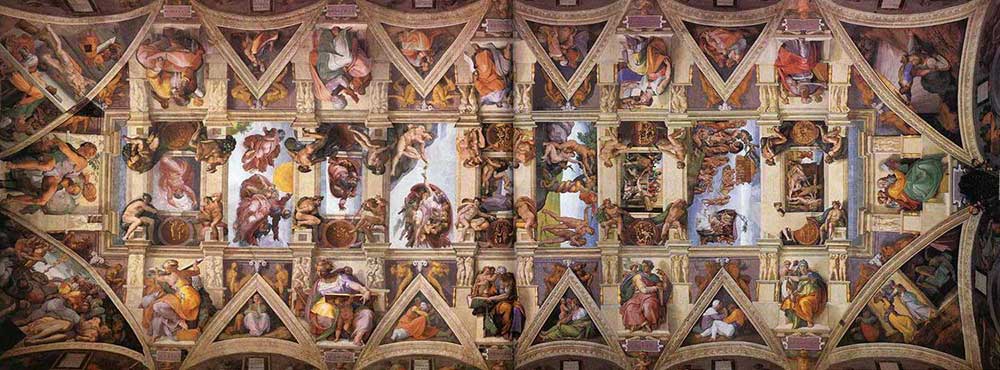
4 – The Creation of Adam and the “brain” of God
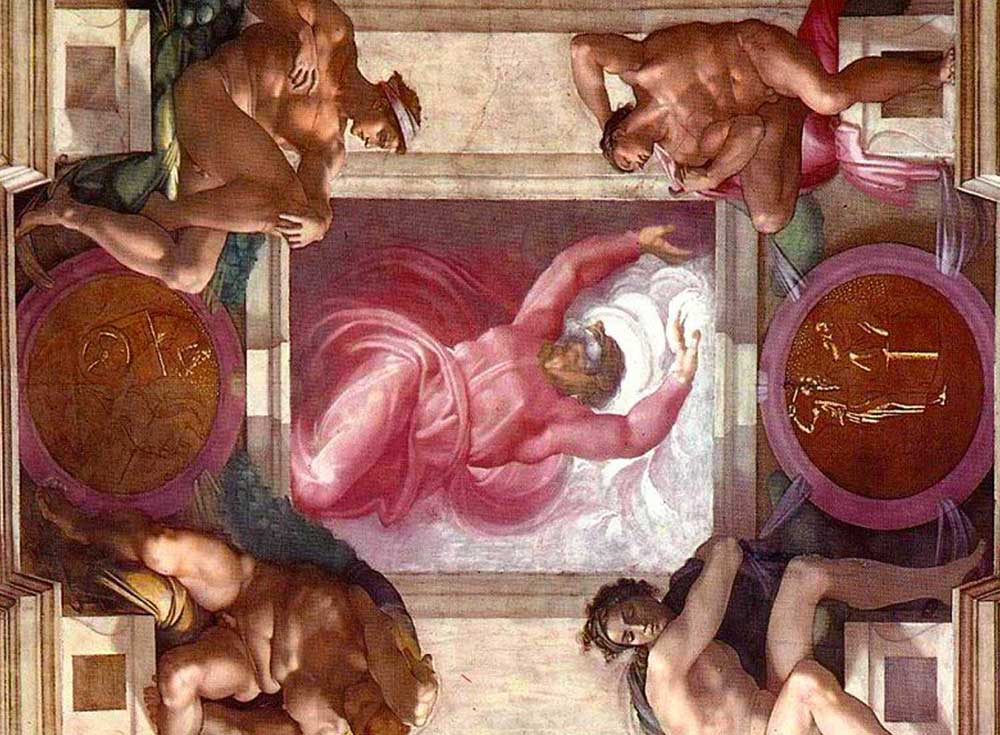
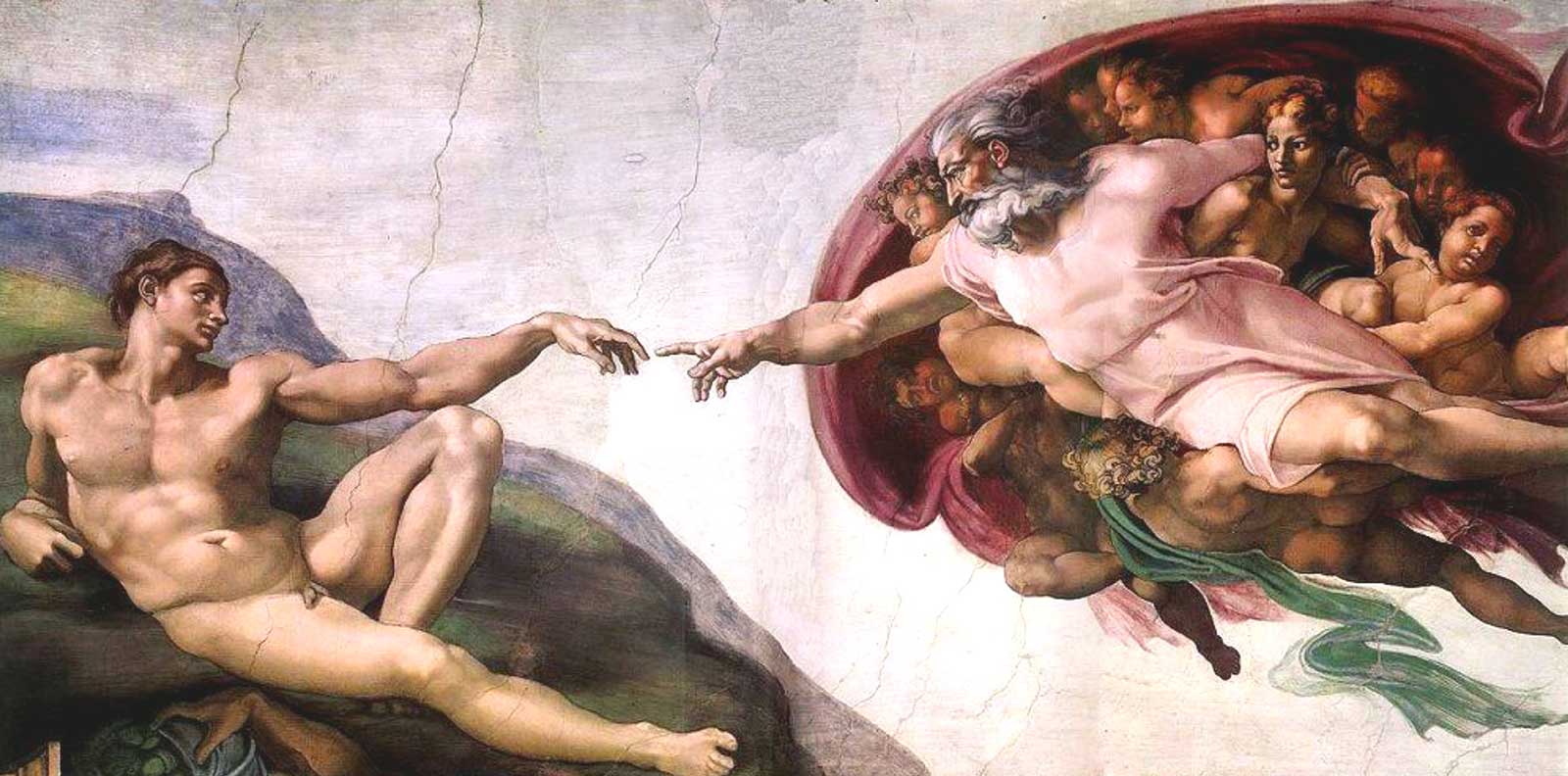
The most famous fresco in the Sistine Chapel is without doubt the Creation of Adam, with the two fingers almost touching.
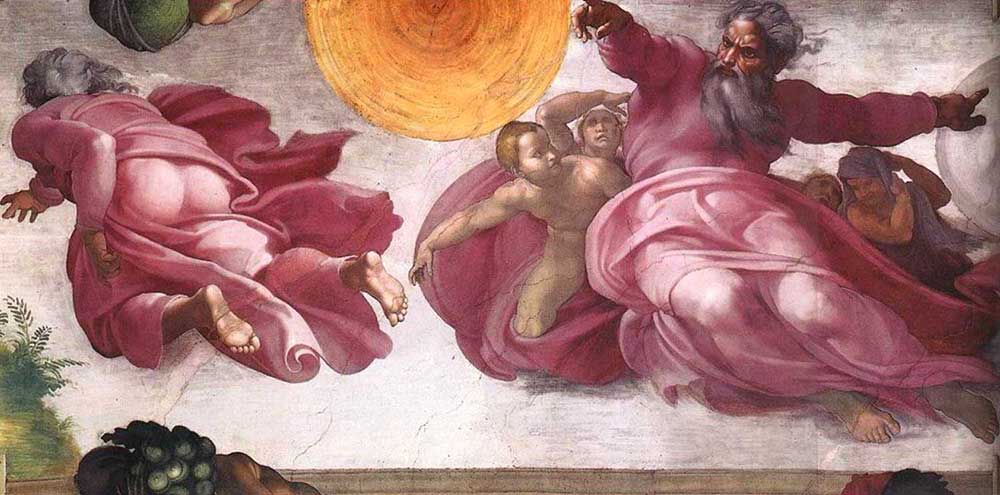
Here Michelangelo did something revolutionary. Before him, God was almost always painted frontally, wrapped in clouds, with his hand pointing downward to judge mankind. Michelangelo instead portrays him in profile, with a muscular body and a long white beard, in motion, almost like a classical deity.
But the surprises do not end there.
In 1990, in the scientific journal JAMA (Journal of the American Medical Association), Dr Frank Lynn Meshberger published a fascinating hypothesis: the shroud and the figures surrounding God would trace the perfect outline of a human brain. According to this reading, Michelangelo wanted to say that the divine gift to mankind is intelligence itself.
It is an interpretation, not a certainty. But next time you look at that fresco, try squinting your eyes.
A curious fact: Michelangelo had a deep knowledge of anatomy thanks to the dissections he practised on corpses as a young man in Florence. It is not so absurd that he hid a brain above our heads.
5 – The Last Judgment, Biagio da Cesena and the Braghettone
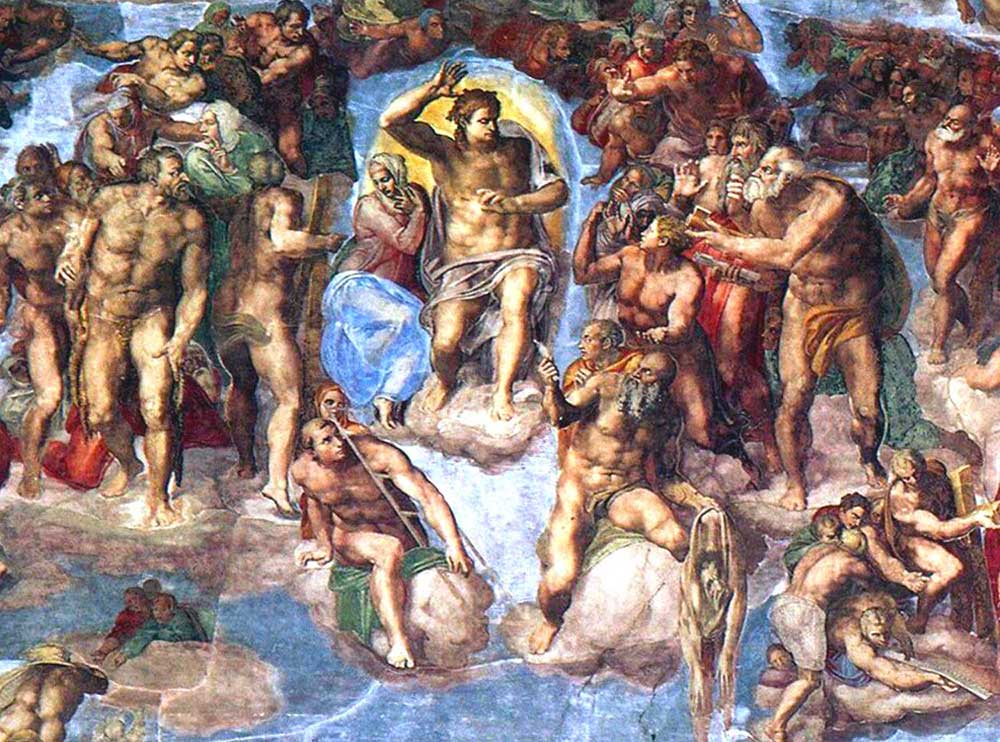
Almost thirty years after the ceiling, Michelangelo returned to the Sistine Chapel to paint the end wall. So the Last Judgment was born, created between 1536 and 1541 on commission from Pope Clement VII and completed under Paul III.
It was a work that caused a great deal of debate, because of the sheer number of nude bodies.
Do you want to know how Michelangelo took revenge on his critics?
The papal master of ceremonies, Biagio da Cesena, judged the fresco indecent, more fit for a tavern than a chapel. Michelangelo repaid him by painting him among the damned in the guise of Minos, judge of the underworld, with donkey ears and a snake coiled around him biting his private parts. It is said that when Biagio complained to the pope, Paul III joked that his authority did not reach as far as hell.
But there is more.
After Michelangelo’s death (which occurred in February 1564), the Church, in the wake of the Council of Trent, ordered the nudities to be covered. The task fell to the painter Daniele da Volterra, who painted veils and drapes over the bodies and earned for this the unflattering nickname “il Braghettone” (the breeches-maker).
A curious fact: in the flayed skin held by the martyr Saint Bartholomew, scholars recognise the self-portrait of Michelangelo. A tormented and poignant way of signing his own work, quite literally putting his skin into it.
Practical information to visit the Sistine Chapel
The Sistine Chapel has no entrance of its own: it can only be visited through the Vatican Museums, of which it is the final destination. Here is what you need to know.
- Opening hours: the Vatican Museums are open Monday to Saturday (hours change with the season, so always check the official website before you travel). On the last Sunday of the month admission is free, but the queue at opening time is very long.
- How to skip the line: the ticket office is one of the nightmares of Rome. I really recommend booking in advance the guided tour of the Vatican Museums and the Sistine Chapel with skip-the-line entry: you save precious hours and a guide helps you read what you are looking at.
- Inside the chapel: silence is required and photography is forbidden. It is not a formality: it protects the frescoes and preserves the recollection of a place that is, first of all, a sacred space. Leave your phone in your pocket and enjoy it with your eyes.
- A tip: do not rush toward the Sistine skipping everything else. The Raphael Rooms and the collections of the Vatican Museums deserve as much time as Michelangelo’s ceiling.
If you enjoyed this journey through the Sistine Chapel, continue with the 9 must-see works of the Vatican Museums or with the full story of Michelangelo Buonarroti. Enjoy your visit!