Are you travelling through Campania and would you like to discover one of the most beautiful museums in Naples? Then you absolutely must treat yourself to a visit to the Naples Archaeological Museum, one of the most important museums in Italy.
The works of the Naples Archaeological Museum are varied and splendid: just think that the museum holds the Farnese collection, finds from Pompeii and Herculaneum, a vast section on ancient Egypt and even one on coins.
But there are also plenty of curious facts about this institution. Before becoming a museum, the building housed a cavalry barracks and, later, the seat of the University of Naples. It was only in 1816 that the Royal Bourbon Museum was inaugurated, enriched with one of the most important collections in the world, both in quantity and in quality.
Okay, but is it only an archaeology museum, or does it have something special?
If the masterpieces of classical antiquity aren’t enough to spark your curiosity (among them is the largest ancient sculpture ever found), let me reveal that one of this museum’s gems is the famous Secret Cabinet: a collection of sculptures and frescoes devoted to eroticism in antiquity, something truly unique in the world.
But I don’t want to give anything away. If you want to discover the finest works, below is my very personal selection of the 7 masterpieces of the Naples Archaeological Museum you really can’t miss.
Fancy discovering them with me?
Let’s go!
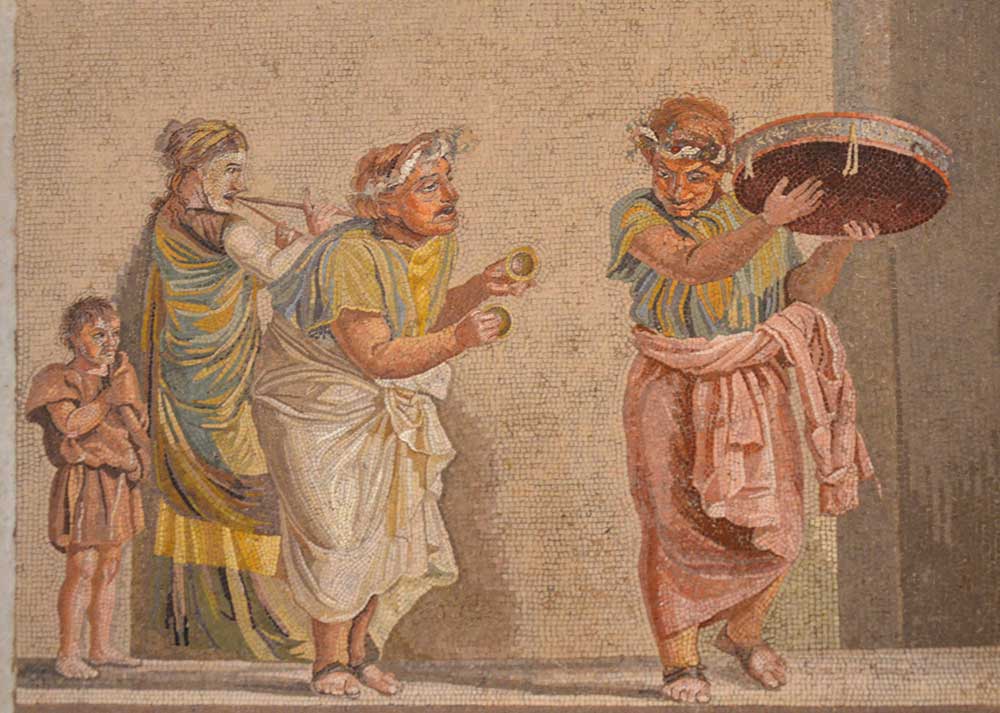
1 – The Farnese Bull
One of the most important works of the Naples Archaeological Museum is the enormous group of the Farnese Bull. You can study it, see it in photos or admire its forms on a computer screen, but when you find yourself in front of it, it’s a whole other feeling.
The group was brought to light in 1545 in the Baths of Caracalla in Rome, during the excavations ordered by Pope Paul III (Alessandro Farnese) to embellish the family palace. It stayed in Rome until 1786, when King Ferdinand IV of Bourbon had the entire Farnese collection moved to Naples, creating the first core of the MANN. The Bull was first used as a fountain in the royal villa and only found its place in the museum in 1826.
Why is it so important?
The Farnese Bull tells, in the most powerful way, the tragic punishment of Dirce. The group captures the exact instant of the myth: the wicked Dirce is about to be tied to the huge bull by the two youths Amphion and Zethus, the sons of Antiope, determined to avenge their mother, for years a victim of Dirce’s abuses. The scene already hints at the ending: the woman will be dragged by the bull up the rocks, to her death.
The beauty and the sheer scale of this work will leave you breathless: astonishing both the realism with which the animal is carved and the drama of the figures. In my view it alone is worth the admission to the Naples Archaeological Museum.
Want to hear a curiosity about the Farnese Bull?
Despite its monumental size, the group is carved from a single block of marble. It is a Roman copy, datable to the 3rd century AD, of a famous Hellenistic original, and in Naples it is considered the largest ancient sculpture in the world: it weighs about 24 tonnes, stands nearly 4 metres tall and rests on a base of almost 9 square metres. When you stand before it, it will seem even more impressive.
You weren’t expecting that, were you?

2 – The inscriptions of the Naples Archaeological Museum
You’ve surely noticed those ugly “tags” and graffiti that stain the walls of our cities. Well, if you thought they were a vice of our own age, you were badly mistaken.
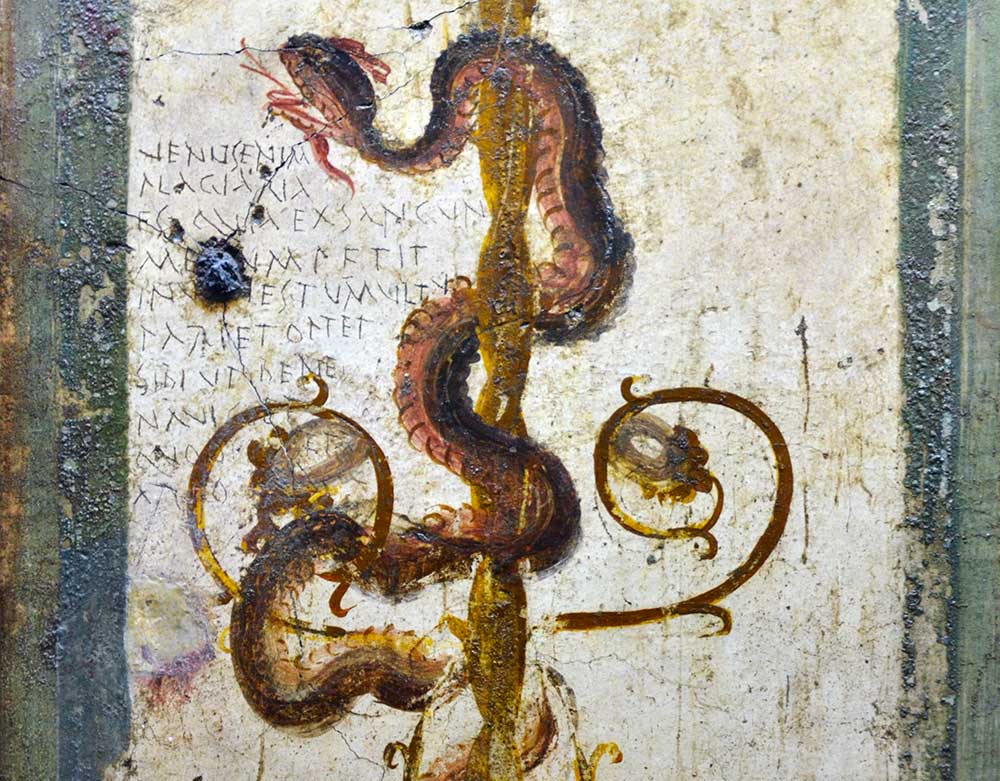
If you’ve had the chance to visit Ostia Antica or Pompeii, you’ll have noticed that here and there along the way there are phrases carved into the bricks or written in charcoal. At the Naples Archaeological Museum you’ll find a whole section of them: inscriptions on stone, clay and terracotta, with a part devoted precisely to those found on the walls of Pompeii and Herculaneum.
Okay, but what are they?
They are texts written on various supports, telling us of distant ages: political propaganda, laws, contracts and everyday life. Just as today there are billposters plastering the city with flyers, or vandals leaving their mark with spray cans, in antiquity they did the same thing, with different means.
A curiosity: it was precisely a charcoal graffito found at Pompeii that reopened the question of the date of the eruption of Vesuvius. For centuries the accepted date was 24 August 79 AD, but that inscription (dated to mid-October) suggests the catastrophe happened in autumn, and not in the middle of summer.
3 – The Egyptian collection
The Egyptian collection of the Naples Archaeological Museum is second in Italy only to Turin’s, but it is the oldest in Europe: the Royal Bourbon Museum was the first, among the great museums of the continent, to devote a section to Egyptian antiquities.
Why are there so many Egyptian finds in Naples?
The original core comes from the collection of Cardinal Stefano Borgia, who towards the end of the 18th century had gathered important pieces from Egypt. On his death, his heirs sold the collection to King Ferdinand I of Bourbon, who bought it around 1815 and opened it to the public in 1821. Among mummies, sarcophagi, votive objects, statues and jewels, you can truly discover the many aspects of ancient Egyptian life.
Today the Egyptian collection of the Naples Archaeological Museum counts more than 2,500 finds, covering some 3,000 years of history, from the Old Kingdom to the Ptolemaic era.
Want to know the most interesting piece?
It’s an archaic sculpture of around 2700 BC, called the “Lady of Naples”. It got this name because it was once thought to depict a kneeling woman, but more recent studies have shown it to be a male official, who lived under the 3rd dynasty.
Much of the collection revolves around the ancient Egyptians’ relationship with the afterlife, with all those objects meant to connect the earthly world with the realm of the dead. It’s one of the sections of the Naples Archaeological Museum that surprised me the most: I never expected to find Egyptian finds so well preserved here.

4 – The Alexander Mosaic (Battle of Issus)
If the Egyptian finds deeply surprised me, the section of the MANN that moved me the most is the one with the mosaics. Seeing the Alexander Mosaic in person was a unique experience.
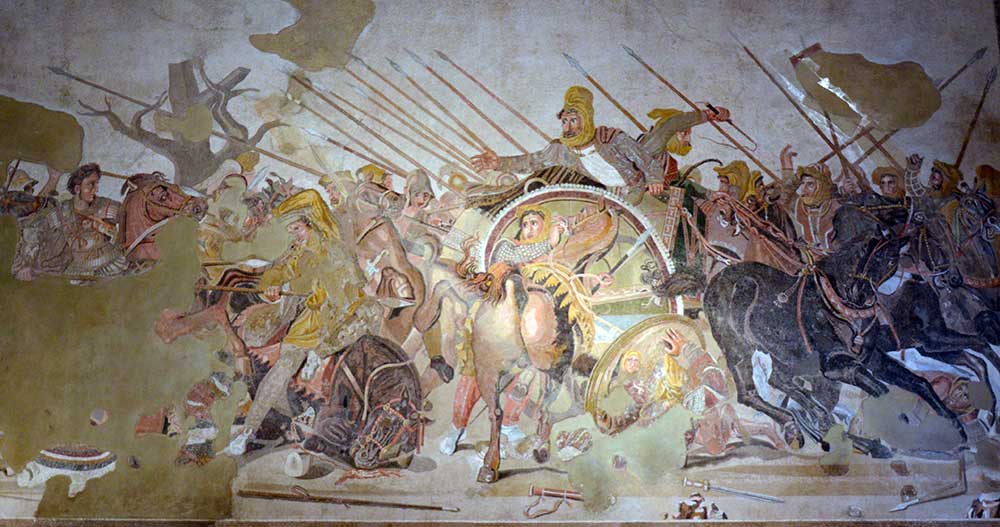
Imagine more than a million tiny tesserae telling one of the most famous battles of antiquity: the one between Alexander the Great and Darius III of Persia, fought at Issus in 333 BC. Like many other works of the Archaeological Museum, the mosaic was found during the 1831 excavations of Pompeii and was part of the floor of the so-called House of the Faun. It is in fact a Roman copy (late 2nd century BC) of an older Greek painting, but no less important for that.
Why is it special?
The work is enormous: 5.82 metres long and 3.13 wide. Although time has damaged it greatly, the figures of Alexander the Great and the Great King Darius III are still clearly visible. The scene is entirely centred on the Persian king, fleeing on his chariot, while Alexander pursues him astride his faithful Bucephalus: the two stare at each other intensely, in a mix of fear and fury.
Here’s a curiosity!
The whole mosaic is made with tesserae in just four colours: white, yellow, red and black. And yet it’s the details that make it one of the finest in history: the turmoil conveyed by the crossing spears, the rearing horses in the background, the gazes rendered with incredible precision. On Alexander’s breastplate you can even make out the leather straps. And there’s a detail that left me speechless: the terrified face of a Persian soldier about to be run over by the chariot isn’t directly visible, but is mirrored, faithfully, in the reflection of his shield.
There are many other incredible mosaics here, above all from Pompeii. Seeing is believing.
5 – A goddess’s best side: the Callipygian Venus
The Callipygian Venus of the Naples Archaeological Museum is one of the most beautiful examples of sensuality in classical art. She is also called the “Venus of the beautiful buttocks” (that’s exactly what callipygian means) and depicts the goddess turning to look back, uncovering her buttocks in a natural yet very original pose for a sculpture.
What is her story?
She is a Roman copy of a Hellenistic bronze original, recovered in Rome without her head, perhaps in the area of the Domus Aurea. In 1594 she entered the Farnese collection, which had the head added; a second, major restoration is owed to Carlo Albacini, around 1786. With the rest of the Farnese collection she then came to Naples. Of the original’s creators, unfortunately, we know nothing.
Why is the Venus showing her buttocks?
At first glance it may seem a provocative pose, but the Callipygian Venus is caught in the middle of the anasyrma, a ritual gesture of the Greek world performed to ward off the enemy or, more generally, misfortune. Whether for the perfectly rendered curves or the unusual pose, this Venus has embodied an ideal of beauty for almost 2,000 years, and still exerts a mysterious fascination on those who admire her in person.

6 – The horse head by Donatello
This masterpiece is one of the works of the Naples Archaeological Museum around which the most legends revolve: a monumental bronze horse head, which you’ll find at the centre of one of the first rooms of the MANN.
Who made it?
For centuries it was thought to be an ancient work, so perfect was its craftsmanship. In reality it is the so-called Carafa Protome, attributed to Donatello as early as Vasari and today officially recognised as his (since 2012). It was Lorenzo de’ Medici who sent it to Naples in 1471, as a gift to his friend Diomede Carafa, a leading figure at the Aragonese court: hence the name, and its long stay in the courtyard of Palazzo Carafa, on Via San Biagio dei Librai. It was probably meant to be part of a large equestrian monument that was never completed.
What legends surround this work?
It is said that the horse head has the power to heal animals: you would just have to walk around the sculpture three times. Another story tells that the rest of the statue was melted down to make the bells of Naples Cathedral, and that only the head was spared.
They are only legends, of course, but over the centuries the Horse Head has become one of the symbols of Naples and of the MANN, a bit like the David by Michelangelo is for Florence. Neapolitans are so fond of it that a reproduction has even been painted on the entrance staircase of the museum.

7 – The Secret Cabinet: love and sex in Roman times
The Naples Archaeological Museum hides a section that for many years was kept secret and censored.
What is it?
The Secret Cabinet (Gabinetto Segreto), the most “scandalous” part of the museum, entirely devoted to the erotic art of antiquity, with plenty of very explicit finds.
Why was it censored?
For the ancients, these depictions of sexuality were something more than normal. But over the centuries they came to be seen as outright obscenities: sexuality became a taboo as early as the Middle Ages, and this section remained closed almost from its creation. During the 19th century the works even risked being destroyed; luckily they were only relegated to private rooms, locked behind a triple lock. Only since 2000 has the Secret Cabinet finally been open to the public, with over 250 works among statues, mosaics and frescoes.
Where were they found?
Like most of the works of the Naples Archaeological Museum, these too come mainly from the excavations of Pompeii and Herculaneum. The most famous piece is a small, celebrated statue depicting the god Pan in the act of coupling with a she-goat: found in 1752 in the Villa dei Papiri in Herculaneum, it has become the unofficial symbol of the section. The act is rendered rather explicitly, with a remarkable attention to detail.
Visiting the Secret Cabinet calls for a certain awareness: we’re talking about a culture very different from our own. There’s nothing to be shocked about, only a chance to open your mind and try to understand how our ancestors experienced sexuality, without judging. I found it a fascinating section. Is it open to everyone? Under-14s must be accompanied by an adult.

Practical information for visiting the Naples Archaeological Museum
The Naples Archaeological Museum is right in the city centre. For me it was the first stop on a journey that led me to discover the Sanità district and the Sacred Mile and the wonderful people who work every day for their city. If you’re planning to visit the Sanità, I recommend this museum to open or close your day: you won’t regret it.
The museum is open from Wednesday to Monday, from 9.00am to 7.30pm (last entry at 6.30pm) and is closed on Tuesdays, with one exception that saves the day for anyone unlucky with the calendar: if the Tuesday is a public holiday the museum opens and takes its closing day on the Wednesday after (checked in August 2026). The full ticket costs 20 euros (reduced to 2 euros for EU citizens aged 18 to 25), and on the first Sunday of the month admission is free for everyone. During the busiest periods it’s worth booking your ticket online, so you skip the queue at the ticket office.
Before you leave, look out for other masterpieces well worth it: the colossal Farnese Hercules, the precious Farnese Cup (one of the most famous cameos in the world) and the wonderful section of Pompeian frescoes, with portraits like the so-called “Sappho”.
And if this journey into antiquity has left you wanting more splendour, I’ll be waiting for you in my guide to the Royal Palace of Caserta, the other great wonder of the Bourbons. Enjoy your visit!