If you’re about to visit Lyon and want an idea of what to see, I recommend spending at least half a day at the Museum of Fine Arts, one of the most important in France, with works ranging from Perugino to Rubens, Rodin and even Picasso.
Unlike the Gallo-Roman Museum, which I also recommend even though it sits in a tucked-away corner of the city, the Museum of Fine Arts in Lyon is right in the centre, on Place des Terreaux, housed in a beautiful 17th-century building that was once a convent (the Palais Saint-Pierre).
Beyond the beauty of the building, here you’ll find splendid collections of painting, sculpture and even ancient art, spread across more than 70 rooms to visit at your own pace. At the entrance there’s also a lovely courtyard with a small garden, where you can take a break and enjoy the sun in spring and summer.
So, have I got you at least a little curious?
Then below I’ll tell you about the works of the Museum of Fine Arts in Lyon that I liked most.
Let’s go!
The Kore of Lyon
The Kore of the Museum of Fine Arts in Lyon was found in Athens at an unspecified date, but we know for certain it’s more than 2,500 years old (it dates to around 540 BC). The first records place the statue in Marseille in the 18th century; that it came from the Acropolis became clear later, when the fragments of the lower body resurfaced, now at the Acropolis Museum in Athens.
Why is it special?
This maiden (in Greek kore) was one of many life-size votive statues buried in the so-called Persian debris (colmata persiana). You should know that, after the plunder of the Persian Wars, the Athenians buried their sacred objects, votive offerings included, so as not to leave them to the enemy and to keep them from being melted down or desecrated.
A practice that turned out to be a blessing for archaeologists, because it allowed us to recover finds datable with certainty to before 480 BC. The korai (maidens) and kouroi (youths) were shown standing, often in the act of offering a gift to the goddess Athena: a fruit, a dish or, as here, a little bird.
But they were not simple statues.
As technique advanced, the folds of the garments began to enhance the forms of the body, rendering ever more plastic, three-dimensional volumes. The famous “archaic smile” lights up the serene faces of these sculptures, and the particularity of the Kore of Lyon is that it’s one of the first with Ionic influence.
Here’s something not everyone knows.
Like almost all Greek and Roman statues, the Kore of Lyon was originally painted in bright colours, which made the earrings, the hair and the folds of the robe stand out. That whiteness we take for granted today is just marble stripped bare by time.

Géricault’s Monomaniac of Envy
Géricault is famous above all for the “Raft of the Medusa”, one of the most celebrated paintings in the Louvre. At the Museum of Fine Arts in Lyon, instead, you can see one of his portraits of the “insane”, painted around 1820.
Why is this series called that?
Simply because the models were all people with mental disorders, each marked by a “monomania”: gambling, theft, the abduction of children, delusions of military command and, as in the Lyon painting, envy. Géricault is thought to have painted them for Doctor Étienne-Jean Georget, a physician at the Salpêtrière, at a time when science was beginning to take an interest in the darkest sides of the mind.
The portrait of the Monomaniac of Envy struck me for its expressive power. She is an old woman, with small, mean, bloodshot eyes and shoulders hunched forward: she seems about to whisper some venomous phrase against someone.
It’s a doubly important painting, because at the time people believed that the features of the face or the shape of the skull could reveal a predisposition to crime or madness. Perhaps that’s also why Géricault focuses only on the faces of these outcasts, yet charges them with details: the envious old woman wears a bonnet that narrows her field of vision, as if forcing her to fix on a single thought. Of the ten original canvases, five survive, now scattered across various museums of the world. In this one, Géricault takes us straight into the depths of the human soul.

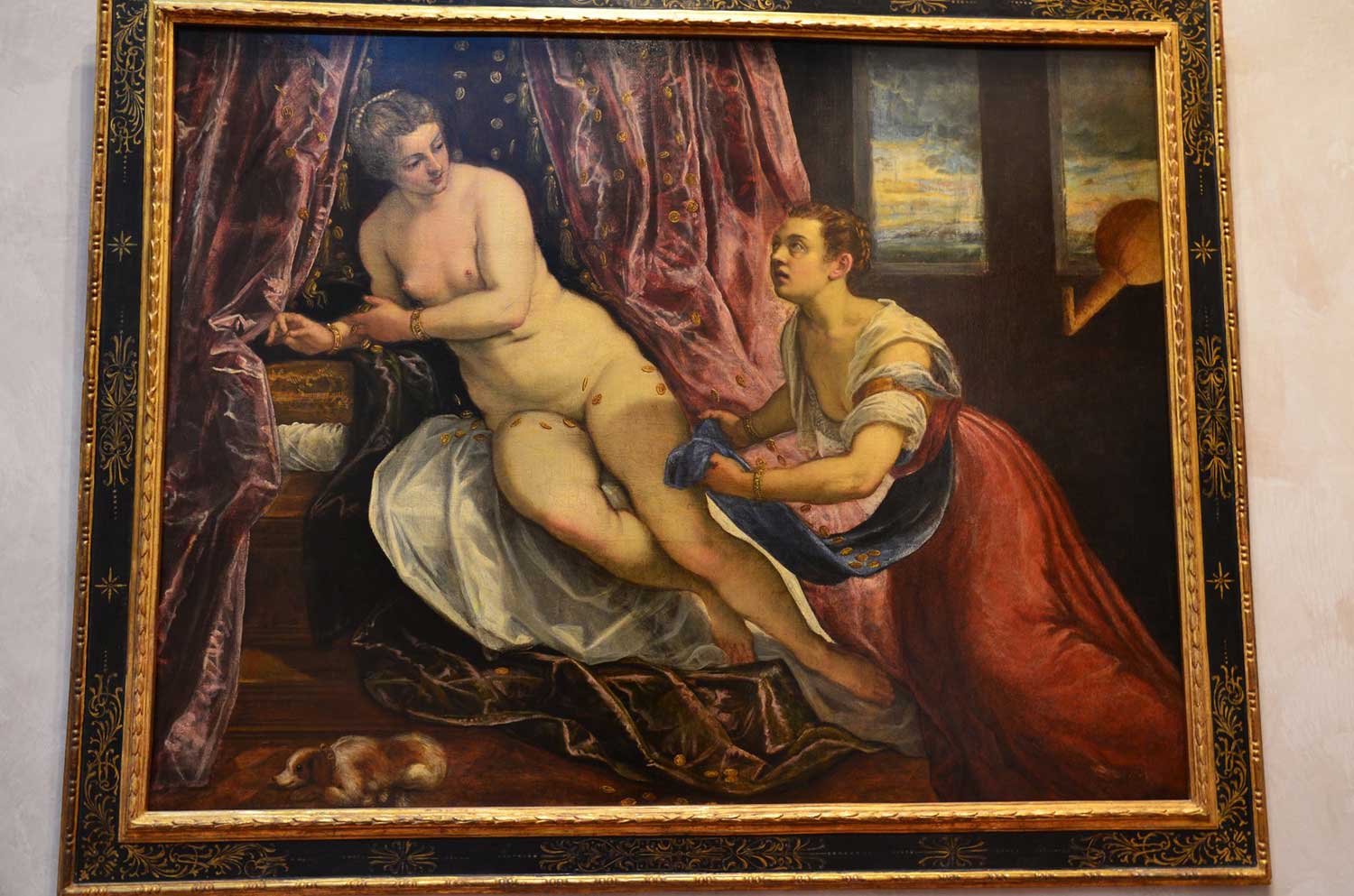
Tintoretto’s Danaë
Impossible not to mention, among the finest works of the Lyon museum, the splendid Danaë by Tintoretto. Jacopo Robusti, called Tintoretto because his father was a cloth dyer (tintore), painted it around 1570.
It’s a wonderful example of Mannerism. The Venetian master was in fact a precursor of the Baroque, for the theatricality of his figures and scenes. Here you’ll be amazed above all by the velvet fabrics, as sumptuous as the curtains of a stage; even the maid’s half-open mouth and the mandolin resting on the window seem to suggest the sounds of a real scene.
But what’s the story?
Beautiful Danaë had been locked away by her father, because a prophecy said he would be killed by his grandson. But Zeus, smitten with the young woman, impregnated her by turning into a shower of gold. This is the very instant Tintoretto captures: the girl and the maid look at each other, while one gathers the golden coins and the other seems to rise, a little incredulous.
Cain and His Race Cursed by God, Antoine Étex
This is one of the works that struck me most at the Museum of Fine Arts in Lyon. Cain and His Race Cursed by God is a sculptural group of extraordinary expressive power, by Antoine Étex.
Made in the 1830s, it portrays a colossal Cain with his head bowed, together with his family, in the deepest despair. After killing his brother Abel, Cain has been cursed by God; but the artist here also expresses all the uncertainty of humanity’s future, in an age of great social, economic and political upheaval, marked by often violent struggles for rights and equality.
The structure of the group is harmonious and forms almost a pyramid, concentrating the tension in an escalation of feeling up to the bowed head of the guilty one: Cain. The message is clear: constant changes of regime, wars and instability make the future uncertain. Inspired by Michelangelo, Étex became, precisely thanks to this group, one of the most important French sculptors of the Romantic era.

Two works by Fleury François Richard
There are two canvases at the Museum of Fine Arts in Lyon that struck me in a special way, even though they aren’t among the most famous: two intimate convent scenes, by Fleury Richard.
This 19th-century painter was a pupil of Jacques-Louis David and enjoyed a fair success in his day, becoming one of the precursors of the Troubadour school, inspired by Northern painting and by historical and medieval subjects.
The two works are Vert-Vert and At the Entrance of the Convent. The first, literally “Green-green”, is inspired by a humorous poem of 1734: the story of a parrot raised in a convent that, for this reason, speaks the language of the devout, before living all sorts of adventures. Here we see it portrayed with two nuns, in a scene of relaxed everyday life: I loved the light, the perspective and the atmosphere.
The second painting is even more curious, because it’s unfinished. If you look closely, you’ll notice two figures hovering like ghosts at the entrance of the convent, shadows of the past that seem to fade away. Richard had a habit of returning to works already completed, and here he decided to add the two women.


Braque’s Violin
Georges Braque painted Le Violon (“The Violin”) in 1911, at the height of Analytic Cubism.
Confused?
Let me explain. The artists of this movement studied reality and broke it down into a play of different planes, fragmenting its forms. The dominant tones are grey and brown, while light is the element that unifies the disassembled objects.
Braque played the violin and deeply loved music: no surprise, then, that he was among the first Cubists to bring musical instruments into his paintings. Here the violin appears as an open, fragmented form, in dialogue with the space around it and with the oval format of the canvas (75 × 60 cm), free of corners.
Here’s a curiosity.
His friend Picasso, too, would use oval canvases in those same years: the two spurred each other on, in a race of experimentation that changed the history of art forever.

Practical information
The visit to the Museum of Fine Arts in Lyon begins with some magnificent 19th-century statues and continues with Sumerian, Celtic, Egyptian, Greek and Roman masterpieces, all the way to the decorative arts of the last century. Combs, vases, furniture, tableware, armour: they lead you through the centuries, from the toiletries of an Egyptian noblewoman to the reconstruction of an Art Nouveau bedroom.
On the second floor, still in chronological order, is the picture gallery, with medieval, Renaissance, Baroque and Neoclassical masterpieces and a fine section devoted to the 20th-century avant-gardes. Don’t miss, among others, Perugino’s Ascension of Christ, the paintings by Rubens and Rembrandt and the sculptures by Rodin.
When I visited, some contemporary works by Pierre Soulages had just been acquired, and I imagine they won’t be the last: I find it wonderful that art doesn’t belong only to the past, but keeps evolving today too.
The museum takes about two and a half hours to visit. It is closed on Tuesdays and open the other days from 10am to 6pm (Fridays from 10.30am); the ticket offices close at 5.30pm (hours and fares checked in August 2026). Admission to the collections costs 8 euros and is free for under-18s.
A tip if you’re staying a few days in Lyon: the Lyon City Card includes entry to dozens of the city’s museums (the Fine Arts included) plus unlimited public transport: if you’re planning several visits, it pays for itself quickly. And to plan the rest of your stay, I’ll be waiting for you in my guide on what to do in Lyon.