
Michelangelo Buonarroti is not only one of the most important artists in the history of art, but also a towering example of genius and uncommon determination. He was born in 1475 in Caprese, and at just thirteen he entered the workshop of Ghirlandaio in Florence as an apprentice.
Everyone knows his marvellous works, but few know the tormented man hiding behind this extraordinary, multifaceted artist.
Did you know that only a few years later he was noticed by Lorenzo de’ Medici himself?
The great patron and lord of Florence immediately recognised Michelangelo’s immense talent and, around the age of fourteen, welcomed him into the garden of San Marco, where the boy could study the ancient sculptures of the Medici collection first-hand under Bertoldo di Giovanni, a pupil of Donatello. It was the best possible environment to stimulate his abilities and his mind: in Florence Michelangelo trained within a circle of Neoplatonic intellectuals such as Pico della Mirandola, Marsilio Ficino and Angelo Poliziano, to name just a few.
After the fall of the Medici and various travels, he arrived in Rome, where he established himself as a sculptor with the Pietà and received his first papal commissions, among them the tomb of Julius II (which occupied him his whole life without ever being finished) and the Sistine Chapel, which at first he had no intention whatsoever of decorating.
In this article I take a brief look at his life and his style, telling you details and curiosities that will help you understand his work and his story as an artist a little better.
Ready to find out more about Michelangelo?
Let’s go!
Michelangelo’s new style
Michelangelo was a true innovator for his time.
His colossal figures, muscular, alive and in constant movement, opened the way to a new kind of art, reaching, as Vasari argued, the very peak of Renaissance art. After him it would be the Mannerists who drew inspiration from these forms and from those of his rival Raphael.
He focused mainly on the study of male bodies, probably driven by the fact that he was homosexual, and maintained his whole life that he was first and foremost a sculptor. Yet his artistic output is as prolific in sculpture as it is in painting, and in architecture too.
In every field of art, Michelangelo Buonarroti is inimitable and stands as one of the defining personalities of the sixteenth century. Vasari even declared that Michelangelo stood at the summit of a long line of artists that ran from Cimabue down to his own time, and that after him there could only be decline.
Michelangelo’s deep torments
As I’ve already said, Michelangelo was a sculptor by choice, a painter by chance and an architect out of necessity, but he was also a poet.
In the biographies and documents that have come down to us, he is described as having a surly, gruff temperament and a strong tendency to work in solitude. In short, he was a very peculiar person.
Although extremely wealthy, he never spent a penny, never washed and rarely changed his clothes, so much so that it is said his boots had become stuck to his feet (which also prompted the irony of Raphael in “The School of Athens”, where he portrayed him sulking and apart, in the guise of Heraclitus).
Perhaps it is this peculiar character and inner turmoil that helped give his works that tension and energy that set them apart. It is as if he could never reach the perfection he sought so intently, in a constant effort to surpass himself.
Famous, in fact, is the anecdote about the Moses, in which it is said that the artist, struck by the realism of his own work, hit it with his hammer, shouting:
«Why don’t you speak!»
Even the ceiling of the Sistine Chapel, for him, was not yet perfect when the Pope wanted to unveil it, which is why he postponed the event several times.

Michelangelo the homosexual
Some believe that the reason for his deep torment was his homosexuality, in conflict with his beliefs as a fervent Catholic.
If you look closely, his male figures are anatomically perfect, while the female ones are clearly masculine.
He is also said to have been deeply misogynistic: the only important woman in his life was the highly cultured Vittoria Colonna, with whom he shared a profound intellectual and spiritual relationship for years.
A new way of understanding sculpture
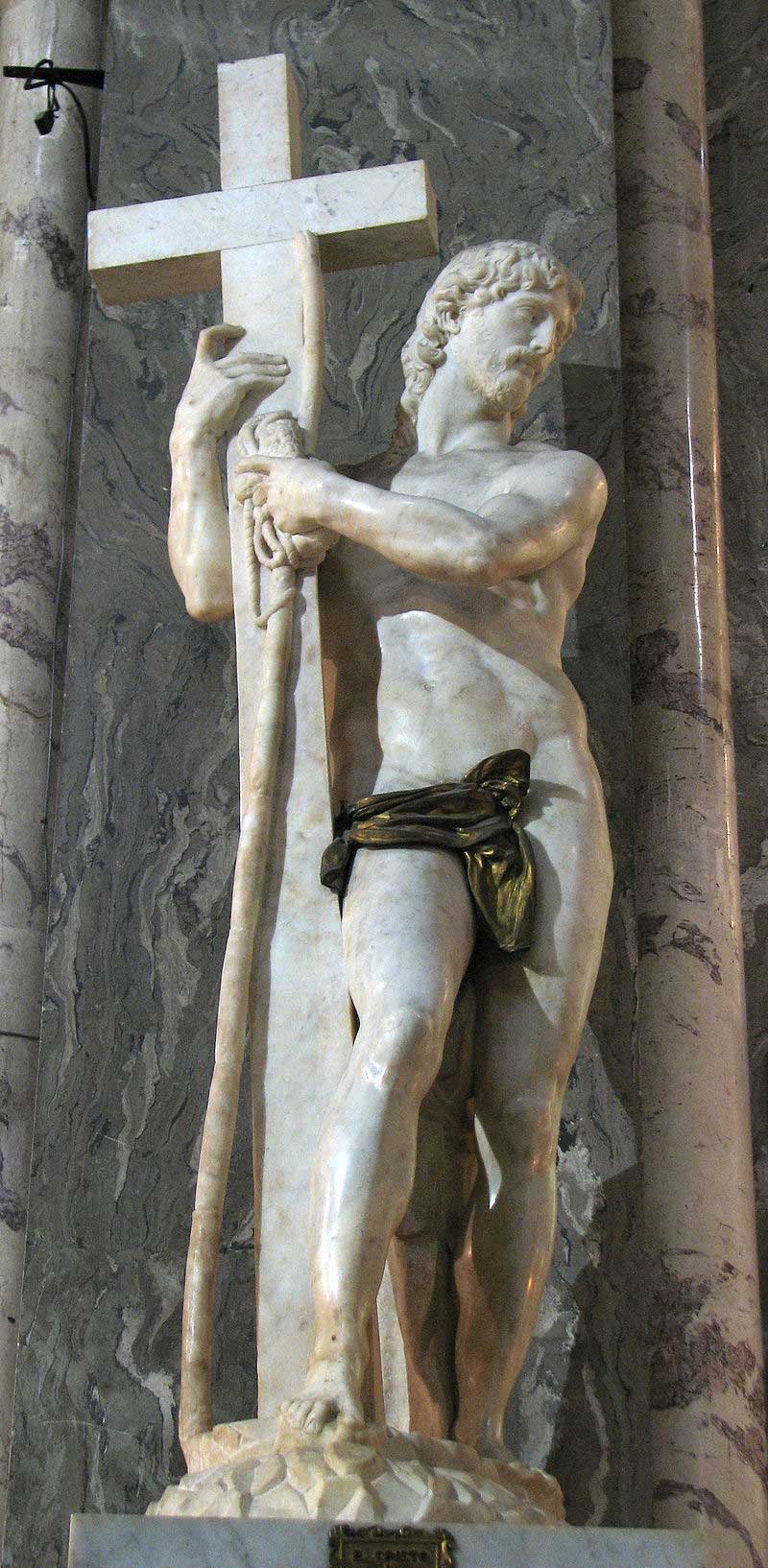
But Michelangelo had a unique relationship with his art, and above all with sculpture. You understand it well when you read this famous line of his: “Every block of stone has a statue inside it, and it is the sculptor’s task to discover it.”
When you look at his unfinished statues, such as the famous Prisoners meant to adorn the sumptuous, never-completed funerary monument of Julius II, you understand exactly what he meant. The statues seem to emerge from the marble, shaped by the artist’s expert hands. They look incredibly contemporary and are magnificent even so, incomplete.
Perhaps for Michelangelo the work of art was already there, inside the rough block, and his task, as an artist, was simply to draw it out and show it to the world.

Michelangelo the poet
One of the clues that lead us to think Michelangelo was homosexual comes precisely from his personal letters or, rather, from the passionate poems he wrote to the young Tommaso de’ Cavalieri and to other young men.
Just think that, after his death, these papers were hidden, destroyed or altered with women’s names to conceal their author’s sexual orientation.
Here is one of the most beautiful poems by this tormented artist:
Come può esser ch’io non sia più mio?
O Dio, o Dio, o Dio,
chi m’ha tolto a me stesso,
c’a me fusse più presso
o più di me potessi che poss’io?
O Dio, o Dio, o Dio,
come mi passa el core
chi non par che mi tocchi?
Che cosa è questo, Amore,
c’al core entra per gli occhi,
per poco spazio dentro par che cresca?
E s’avvien che trabocchi?
Where to admire Michelangelo’s works
The wonderful thing about Michelangelo is that his works can still be seen in person, scattered mainly across Florence, Rome and the Vatican. Here is where to go looking for them.
In Florence, his adopted city, stands the most famous masterpiece of all: the David, kept at the Accademia Gallery. I have to confess that seeing it in person is an emotion hard to describe: it is far bigger than you imagine (over five metres) and the queue at the entrance can be daunting, which is why it’s worth booking a skip-the-line ticket. In the same gallery you’ll also find the famous unfinished Prisoners, while in the Medici Chapels you can admire the tombs of Giuliano and Lorenzo de’ Medici with the allegories of Day, Night, Dawn and Dusk.
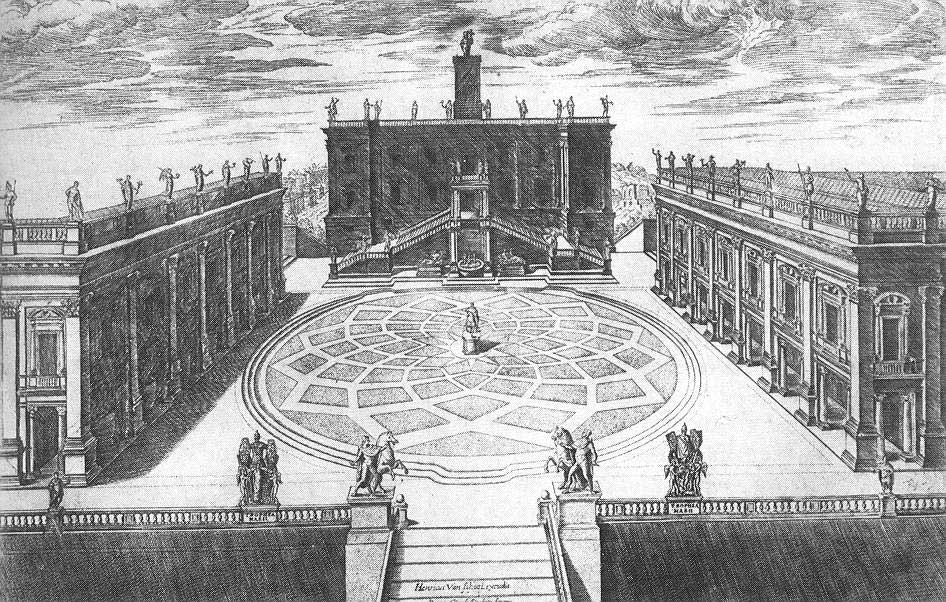
In Rome two more absolute masterpieces await you: the Pietà, in St Peter’s Basilica (the only work Michelangelo ever signed), and the powerful Moses, the heart of the tomb of Julius II, in the church of San Pietro in Vincoli. And if you climb up to the Capitoline Hill, you walk across the square Michelangelo himself designed: today it is home to the Capitoline Museums.
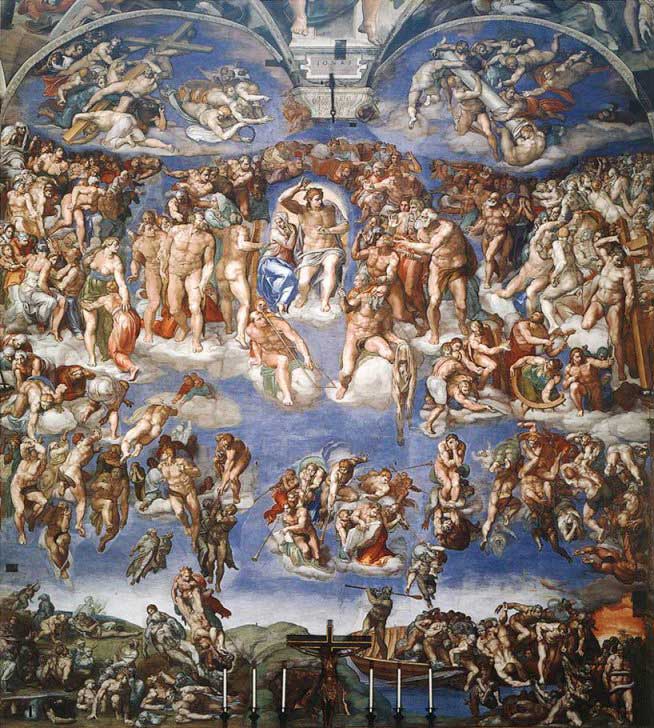
And finally the Vatican: the ceiling and the Last Judgment of the Sistine Chapel are visited through the Vatican Museums, and it is perhaps the most overwhelming experience Michelangelo’s art can give you.
A curiosity: his very last work, the Rondanini Pietà, left unfinished, now stands far from all the others, in the Sforza Castle in Milan: he worked on it until just a few days before his death.
The death of Michelangelo
He worked until his death, which came in Rome in 1564, when he was by then 88 years old, after living a thrilling life and witnessing the turn of an age: from the Renaissance of Lorenzo the Magnificent to the Counter-Reformation that followed the sack of Rome.
A detail you may not know: Michelangelo wished to be buried in his beloved Florence, but Rome wanted to keep him. So his nephew Lionardo had the body smuggled out secretly, shipped out of the city wrapped like ordinary merchandise, to reach the Basilica of Santa Croce, where he still rests in a monument designed by Vasari.
An absolute genius, a great artist but also a man who, like so many, was denied happiness by the prejudices of his time.
If you love his art, I recommend carrying on with the curiosities about the Sistine Chapel and with Raphael’s irony in “The School of Athens”, where Buonarroti appears in a corner, sulking as ever.
His lesson reached the painters of the next generation too: Jacopo Pontormo took his forms and pushed them towards something restless and new.