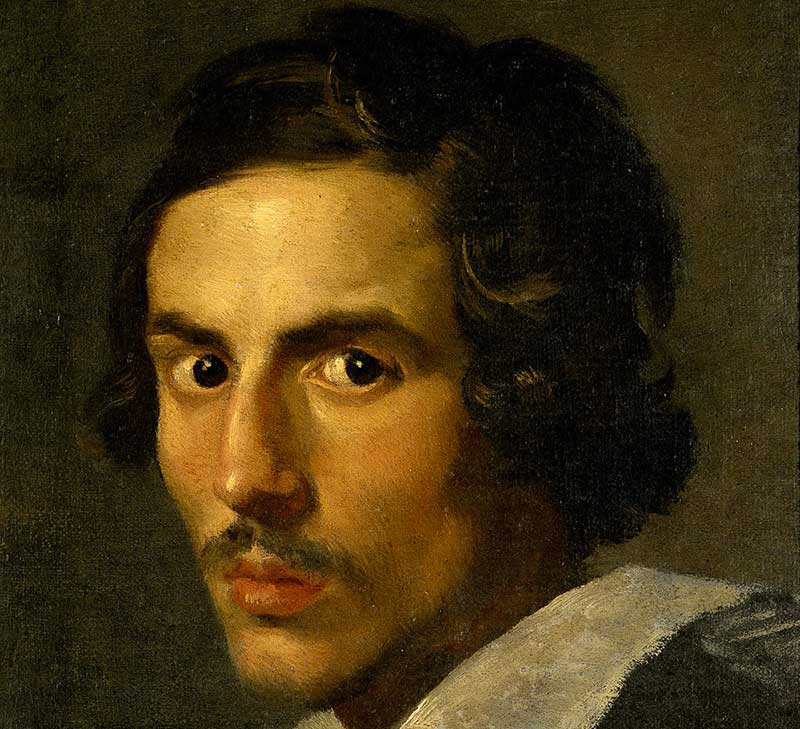
Among all the artists of the Italian Baroque, Gian Lorenzo Bernini is surely one of the best known and most admired, as well as one of my absolute favourite artists. Together with his famous rival Francesco Borromini, he created some of the most beautiful and important works in Rome.
Among the most important works by Bernini, you have surely seen the Fountain of the Four Rivers in Piazza Navona or the Triton Fountain in Piazza Barberini. But all over the Italian capital you can find statues, churches or entire buildings designed and made by this great artist.
Born in Naples in 1598, Bernini was born into art: his father Pietro, of Florentine origin, was soon called to work on the building site of Santa Maria Maggiore in Rome and, from the earliest years, realised his little son’s precocious talent.
Thanks in part to his father’s work, Bernini’s life unfolded mainly among the various Roman building sites. He grew up among the great architects and sculptors of the previous generation, learning and training on their works. It was precisely for this reason that, from a very young age, he managed to attract the attention of both the Pope and Cardinal Scipione Borghese.
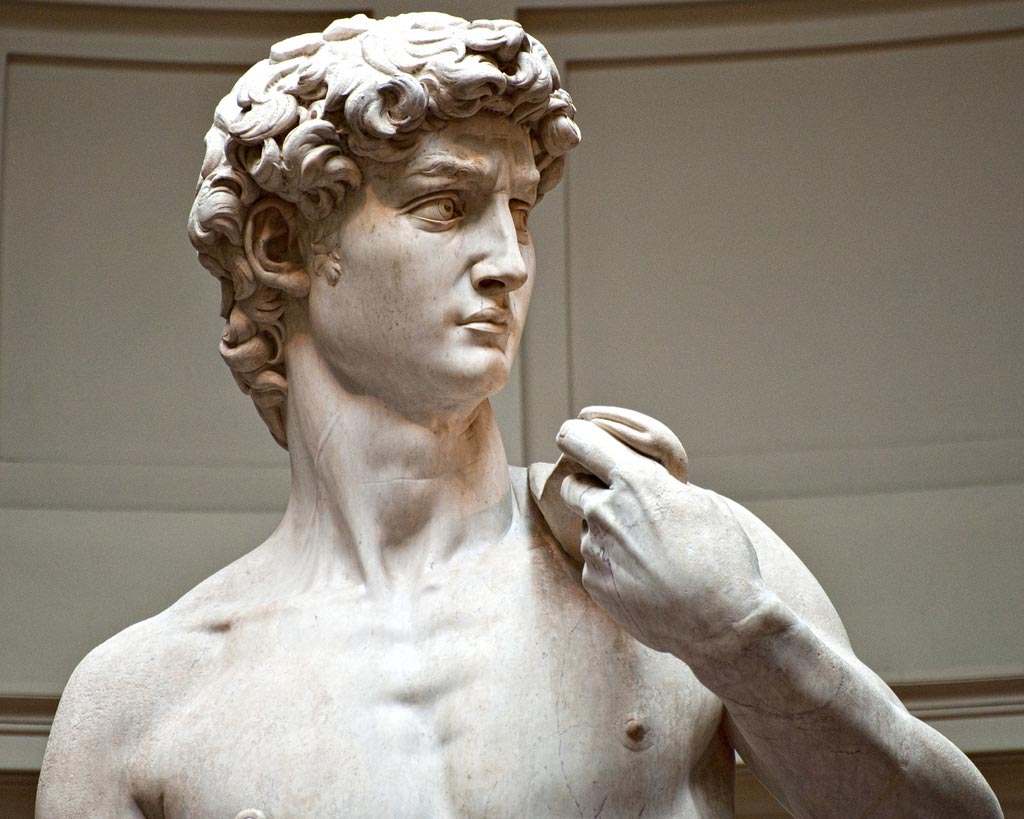
It is no coincidence that the first works by Bernini to achieve great fame are the magnificent sculptural groups of the Galleria Borghese, Aeneas and Anchises and The Rape of Proserpina, which he carved when he was barely in his twenties, the David and also the splendid Apollo and Daphne, from 1625.
But Gian Lorenzo’s career was extremely rich in satisfactions and studded with marvellous works that kept him busy for many years.
You know the great bronze baldachin inside St Peter’s Basilica?
It took a full nine years to complete, but throughout his career Bernini was capable of creating so many masterpieces that it would be impossible to discuss each of them in depth.
That is why in this post I’ll tell you about this genius of the Roman Baroque, showing you 10 of his most important works and telling you the funniest anecdotes about his life.
Would you like to get to know them?
Let’s go!
Read also: Bernini and Borromini, 6 things to know about their legendary rivalry
1 – Bernini and the colonnade of St Peter’s
When you think of Bernini, one of the first things that comes to mind is the magnificent colonnade of St Peter’s in the Vatican.
Built to balance Maderno’s façade, the colonnade designed by Bernini has an oval shape and is made up of no fewer than 284 columns arranged in four rows: a true masterpiece of architecture and precision.
There are two points, inside St Peter’s colonnade, from which you can see the structure as if it were made of a single row of columns: the perspective created by Gian Lorenzo is so perfect that the other three rows are completely hidden by the innermost one.
The two viewing points are marked by a marble disc reading: centro del colonnato! (centre of the colonnade).
I absolutely recommend you look for it!
Beyond that, St Peter’s colonnade is a truly extraordinary feat of engineering. When you find yourself inside it you’ll have the sensation of being literally embraced by the columns, and your attention will immediately be directed towards the entrance of the basilica, which is reached through the Vatican Museums.

2 – Saint Bibiana
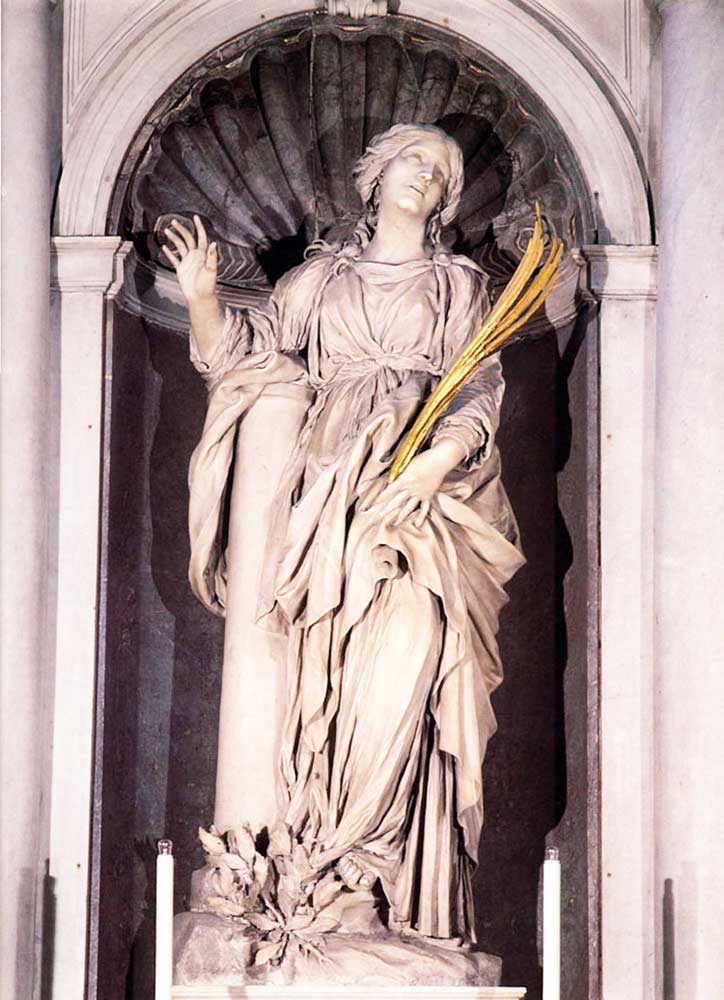
Bernini’s statue of Saint Bibiana is special because it is one of the first sacred works commissioned from the artist, focused on the theme of martyrdom. The statue stands in the eponymous church in Rome, where the relics of the saint are kept together with those of her sister and mother, also martyred.
Bernini chose to portray the saint holding the palm of martyrdom: her head, tilted to one side, wears an ecstatic expression that contrasts with the lively movement of her robe. Beside her is a column because, according to tradition, the saint was tied up and flogged to death with lead-tipped rods.
It is very interesting how Bernini tried to convey the emotions of the woman, right on the verge of being flogged. Her gaze is turned towards the sky, in search of salvation, but it is above all in the folds of her clothes that you can read her psychological turmoil.
One interesting thing to notice is that, exactly at the point the saint is looking, there is a fresco depicting God the Father.
The choice of the statue’s position is not accidental either.
Inside the church of Santa Bibiana, this is in fact the only statue placed within a niche with a dark background. A device that lets you catch every detail of Bernini’s work, in a beautiful play of light and shadow.
3 – Apollo and Daphne at the Galleria Borghese
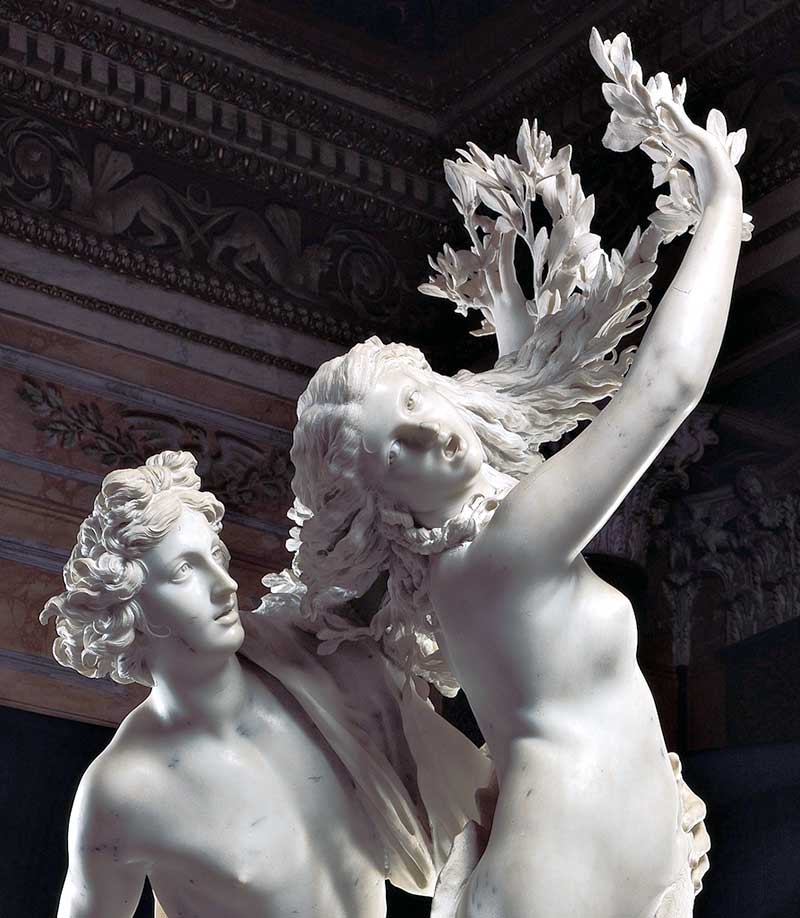
In this sculpture Bernini takes up the myth of Apollo and Daphne and depicts the moment when the god grabs the nymph who is about to turn into a laurel tree.
The nymph’s metamorphosis is taking place before Apollo’s incredulous eyes. Daphne’s hands are turning into branches and leaves while her legs take the shape of trunk and roots. A perfect example of how the artist could give plasticity to marble.
It is said that the marble leaves are so thin that, if you blow on them, they vibrate.
The work is kept inside the Galleria Borghese in Rome, together with other masterpieces by the artist including the beautiful Rape of Proserpina, which I’ll tell you about shortly. Keep in mind that entries to the gallery are limited to timed slots: it’s worth booking your ticket online to be sure of getting in.
4 – The Ecstasy of Saint Teresa in Santa Maria della Vittoria
The Ecstasy of Saint Teresa is surely one of the most “theatrical” works by Bernini. The sculpture depicts an angel in the act of piercing the saint, just as it is vividly and ecstatically recounted by the saint herself.
The sculpture is inside the Cornaro Chapel in Santa Maria della Vittoria and was made between 1647 and 1652 for Cardinal Federico Cornaro, who commissioned Bernini to build his family chapel. The artist was not going through a particularly good moment in his career because of the new pope, Innocent X, and so he decided to do his utmost to impress the new pontiff too.
The result is one of his most celebrated and admired works.
That’s why you absolutely must see it!
The Ecstasy of Saint Teresa stands exactly at the centre of the chapel, surrounded by false balconies where members of the Cornaro family look on. The whole thing is arranged as if it were the centre of a theatre with spectators watching, while the saint sits on an imaginary stage with a cherub piercing her.
Even the study of light is perfect. Just as in Sant’Andrea al Quirinale, Bernini manages to open a small window with yellow glass, completely invisible, that lets the light filter through as if it were a spotlight.
The depiction of the saint is simply spectacular.
Saint Teresa is portrayed half-reclining on a cloud while the little angel on her right pierces her with a dart, symbol of God’s love.
One of the details that will surprise you most is the mastery with which Bernini rendered the folds of the saint’s robe. The garment looks so vaporous and incorporeal that, together with the cloud, it gives the work a sense of extreme lightness: the impression you get is that the statue is literally flying away.
Do you want one more reason to discover this work by Bernini?
The visit to the chapel is completely free!

5 – The Fountain of the Four Rivers
One of Bernini’s most famous fountains is the Fountain of the Four Rivers in Rome.
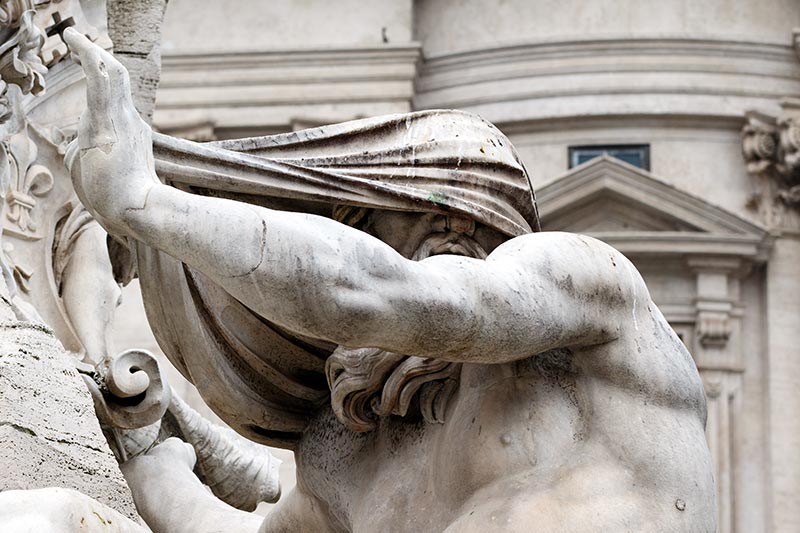
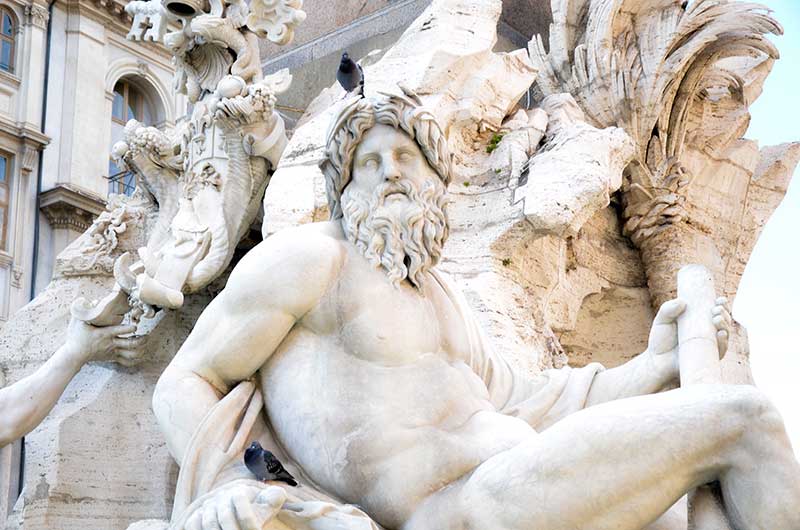
The fountain stands in Piazza Navona and represents the four rivers of the world, one for each then-known continent: the Ganges for Asia, the Danube for Europe, the Nile for Africa and the Río de la Plata for the Americas.
The four huge statues sit around a rock, hollowed out in the centre, on which an ancient obelisk rises (did you know that Rome is the city with the most obelisks in the world? It counts a full 13 ancient ones, 8 Egyptian and 5 Roman).
All around are the elements that characterise each river: plants, animals and treasures. The Nile, for example, has its head covered by a veil because, at the time, its sources were unknown.
A curiosity: if you’re wondering why the strange armoured animal next to the Río de la Plata looks so bizarre, it’s because it is an armadillo, a creature of the Americas that no one in Rome had ever seen. That’s why it was rendered as a sort of large lizard wearing “armour”.
Strange, isn’t it?
6 – The Triton Fountain
Among the most beautiful works by Bernini there is surely the Triton Fountain.
The fountain stands in Piazza Barberini in Rome, a short distance from the Fountain of the Bees, also by Bernini. Despite its apparent simplicity compared with the artist’s other fountains, the Triton Fountain is a masterpiece from the point of view of the study of weights and forces.
If you look closely, the whole fountain is supported by the slender tails of four dolphins that leave a large empty space in the middle. Bernini loved surprising his patrons with effects of this kind, which not only give his works a much more slender appearance, but also show off his enormous skill in distributing weights.
Here’s a curiosity: some years ago the Triton Fountain was completely restored and lost much of the incrustations and moss that gave it an even more “marine” look. The people of Rome grew so suspicious that they believed the statue had been replaced with a copy.
To learn more: 5 things to know about the Triton Fountain in Rome and a few anecdotes

7 – The Rape of Proserpina at the Galleria Borghese
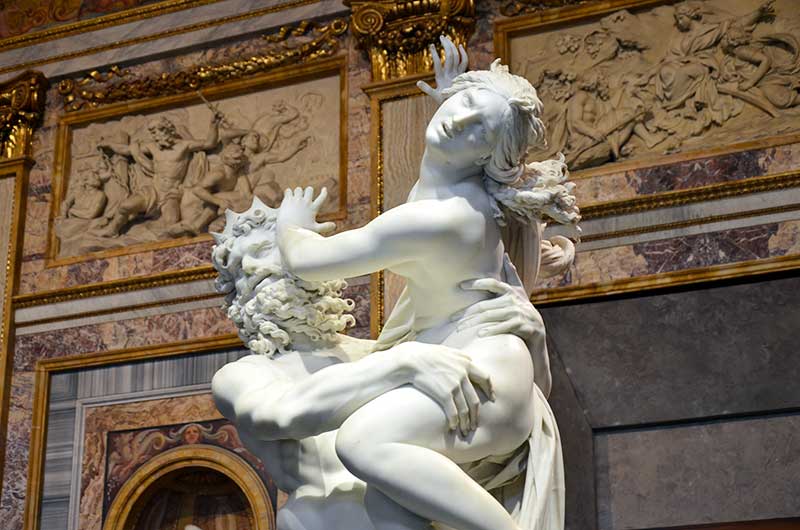
This sculpture draws on another tale from mythology and in particular narrates the abduction of Proserpina, daughter of Jupiter and Ceres, by Pluto.
If you want to go deeper I refer you to this article on the Galleria Borghese; here instead I’d like you to notice how realistic the god’s hands are. They grip the legs of the beautiful Proserpina so vigorously that they seem to sink into her skin, as if it were really made of flesh and bone.
Bernini’s Rape of Proserpina is also marked by some details that underline the artist’s genius. A tear is visible running down the young woman’s face, while the muscular back of the god Pluto is graced by a mole carved in the marble.
I find it one of his most beautiful works!
8 – The Barcaccia in Piazza di Spagna
Although it looks extremely simple, the Barcaccia in Piazza di Spagna is a one-of-a-kind work.
It stands at the foot of the Spanish Steps of Trinità dei Monti and Bernini had to face a considerable problem: the water pressure was not sufficient to make it work.
For this reason the fountain was built by digging down into the ground, so as to guarantee a sufficient flow of water.
Although many believe it was made by Gian Lorenzo alone, it is in fact one of his early works and for this reason it was carved together with his father Pietro.

9 – Bernini’s little elephant
If you’re taking a stroll near the Pantheon, don’t forget to visit the church of Santa Maria sopra Minerva. It’s a building not very well known in Rome, but it’s really worth visiting.
In front of this magnificent structure stands another of the obelisks of Rome, supported by a little elephant conceived by Bernini.
The obelisk was brought from Egypt in Roman times, while the elephant dates from 1667 and has an amusing meaning: its tail is shifted to the left to better show its “rear” to the Dominican convent behind it.
One of the many provocations the artist enjoyed slipping into his works.

10 – Sant’Andrea al Quirinale
Do you want to discover one of the most beautiful churches in Rome?
Sant’Andrea al Quirinale is one of the most beautiful works by Bernini: a small building that will nonetheless seem much larger to you, thanks to the artist’s skill and an ingenious play of perspectives and light effects.
The church of Sant’Andrea al Quirinale sums up the concept of Bernini’s Baroque art. It is a perfect synthesis of architecture and sculpture, inseparably united.
Starting from the façade, this work by Bernini is articulated in recesses and projections so as to give the impression of a dilated space. The effect must have been even more pronounced at the time it was built, because the staircase was later modified, spoiling the result.
But the real masterpiece of this church is inside!
Bernini’s work is entirely centred on the dome of Sant’Andrea al Quirinale, which soars with its oval shape and its “extremely Baroque” gilded coffers. As with the façade, here too it is a device to dilate space and make it seem larger.
The central altar, which houses a canvas by Guillaume Courtois, is entirely decorated with stuccoes and gilded statues. All this, together with the lighting cleverly studied by Bernini, makes this place incredibly rich and gleaming, yet not without an aura of contemplation.
White and gold will surround you, creating an ascending rhythm that rises towards the natural light right behind the altar. You’ll really have the impression that the saint is moving towards heaven. As inside Santa Maria della Vittoria, the artist’s intent was in fact to create an almost theatrical scene, which the faithful are called to witness.
Beautiful!
Do you want to know a curiosity?
The church of Sant’Andrea al Quirinale was willed and financed by Cardinal Camillo Pamphilj (with the approval of Pope Alexander VII) for the Jesuit novitiate, which still runs it today. Bernini considered it his most successful work and, in his old age, he would often come here to pray: his son Domenico tells us so in the biography he devoted to his father.
If you want to discover other things to see near the Quirinale, don’t miss the chance to also visit the smaller San Carlino alle Quattro Fontane. It’s on the same street, not far from Sant’Andrea al Quirinale, but it was built by another genius of the Baroque: Francesco Borromini.

Gian Lorenzo Bernini: the artistic career
As you’ve probably gathered, Bernini’s career was brilliant and full of great satisfactions: he drew inspiration from Hellenistic art and from Michelangelo, but he was a child of his time and the Baroque shows in every one of his works. One of Bernini’s hallmarks is his ability to fuse architecture, sculpture and even painting to create a unified, harmonious whole.
Among Bernini’s most famous works there are surely some of the most beautiful fountains in Rome, including the Barcaccia in Piazza di Spagna, carved alongside his father, the splendid Fountain of the Four Rivers in Piazza Navona, the Triton Fountain and the Fountain of the Bees in Piazza Barberini.
All masterpieces that still today draw thousands of tourists from all over the world. But it’s not over!
There are also very many churches in Rome designed by Bernini, from Sant’Andrea al Quirinale to the colonnade of St Peter’s Square, plus its baldachin and the altar of the Vatican basilica. And also the staircase of Palazzo Barberini, the Chigi Chapel in Santa Maria del Popolo, the monumental tomb of Alexander VII in St Peter’s, and the list goes on almost endlessly… in short, in Rome, wherever you turn, you find something by Bernini!
The wonderful thing is that almost all these works can be admired for free: the fountains are out in the squares and the churches (Santa Bibiana, Santa Maria della Vittoria, Sant’Andrea al Quirinale, Santa Maria sopra Minerva) are free to enter. The only one that requires a ticket and a booking is the Galleria Borghese, where four of his masterpieces await you.
Bernini and the anecdotes about his private life
Bernini’s private life is rich in passionate, spicy details, as in the case of his fierce antagonism with Borromini or those concerning his love rivalries.
One of the most famous episodes was when he discovered that his lover, Costanza Bonarelli, had also been the lover of his brother Luigi. From the chronicles of his life, written by his son Domenico Bernini, we find the episode recounted like this:
“…for, whether out of jealousy of her, or carried away by some other cause, since love is blind, he ordered one of his servants to do her some affront…”
That is, he sent his servant to slash the girl’s beautiful face, while he chased his brother on horseback, sword in hand, right into Santa Maria Maggiore in Rome.
You’d never have expected it, would you?
Some say that in the end it was his mother who begged Cardinal Francesco Barberini to send Gian Lorenzo away for a while, as she feared for the safety of her younger son, but it was the pontiff himself who intervened in the artist’s favour.
In the end the matter was resolved with the imprisonment of the poor servant and of Costanza herself, condemned for adultery. Urban VIII, however, in exchange for the pardon, forced Gian Lorenzo Bernini to take a wife, by whom he had no fewer than eleven children.
He died in 1680, just a few days before turning 82.
At his own wish he was buried in a very humble tomb in Santa Maria Maggiore in Rome. If you want to know where Bernini’s tomb is, you’ll find it on the floor to the right of the altar, bearing only the brief inscription “IOANNES LAVRENTIVS BERNINI DECVS ARTIVM ET VRBIS HIC HVMILITER QVIESCIT”.