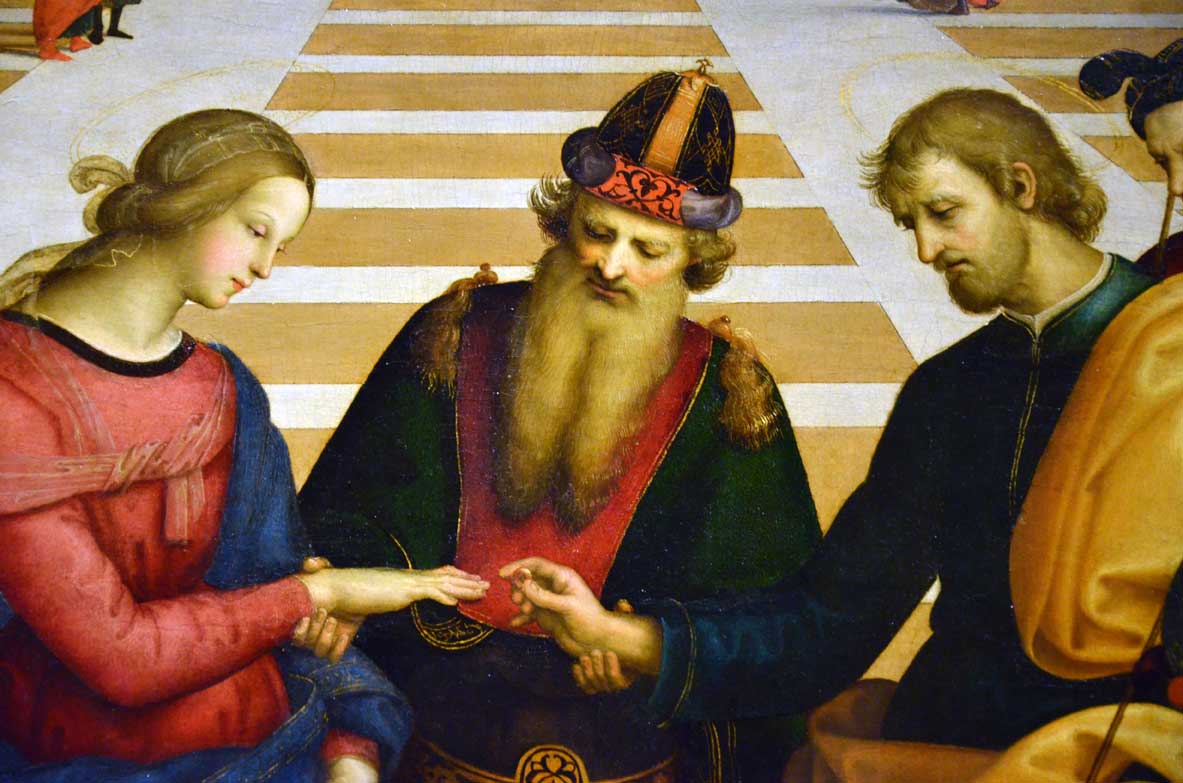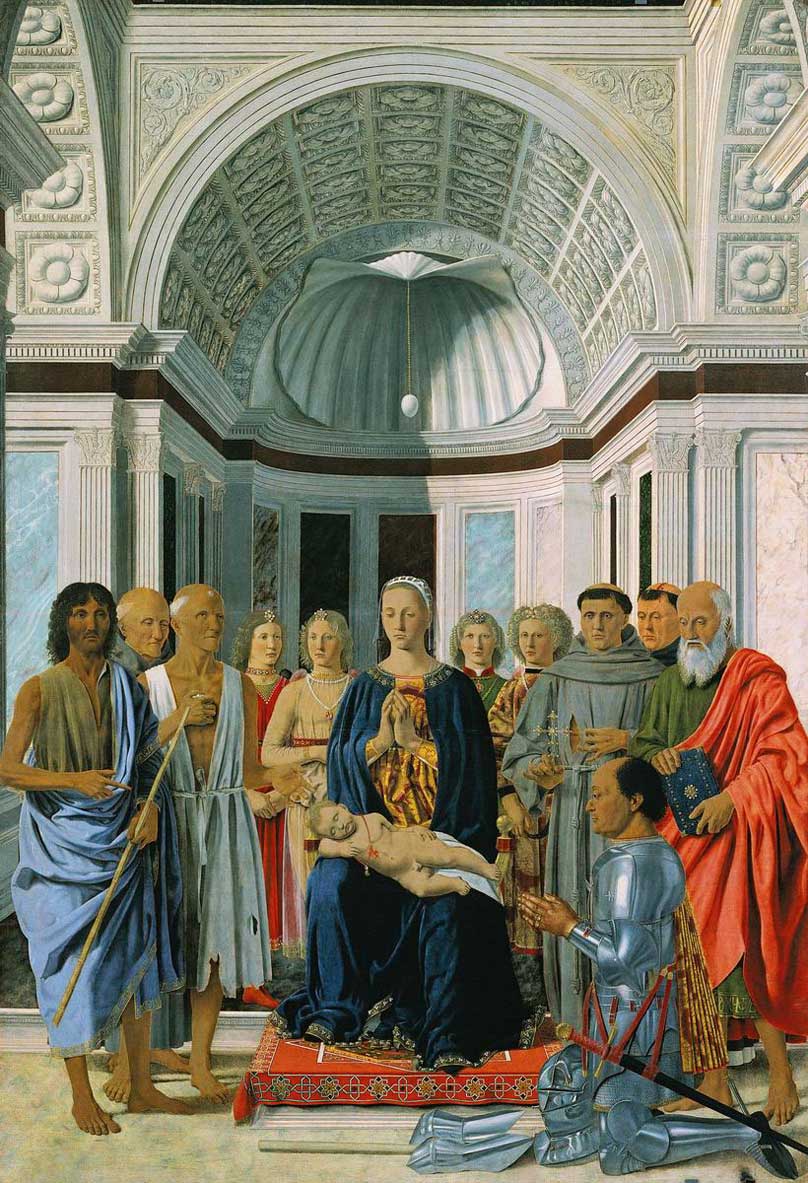

When I think about the capital of Lombardy, the first two things that come to mind are the beautiful Pinacoteca di Brera and the wonderful Milan Cathedral. The first for its remarkable collection of artworks, the second, though certainly not for importance, for its history.
If you started reading this article because you are looking for practical information to buy tickets for the Duomo of Milan or for the terraces, you will find everything in the dedicated section further down. Here I explain what you need to know to get to the top of the Milan Cathedral and enjoy one of the most beautiful views over the city. In my experience, in fact, the ticket offices of Milan Cathedral are always very crowded and you risk standing in line for an hour.
If instead you want to discover the history of Milan Cathedral, the curiosities and the most important artworks, I suggest you read the whole post. I promise not to bore you.
Did you know, for example, that it took more than five hundred years to build the cathedral of Milan?
Five centuries in which artists, architects, projects and ideas transformed the Milan Cathedral into an absolutely surprising building, unique in the world.
On the main spire, you will surely notice the statue of the famous Madonnina, made of gilded copper.
Would you ever guess that it is more than 4 metres high?
The church is in fact dedicated to Santa Maria Nascente and represents one of the most beautiful and significant examples of Gothic architecture in Italy and in the world.
But the Milan Cathedral is a unique structure for a very specific reason: precisely because of the long duration of the works, artistic elements of different origins merged perfectly in its interior and its architecture. Among the most evident are the typically northern ones and the strictly local ones.
In short, there is much more to discover about the most important church in Milan, for example: what are the origins of Milan Cathedral? What to see inside, and how to reach the top?
If you have the patience to read on, I will answer all these questions and you will also discover some curiosities that not everyone knows.
Want to learn more?
Let’s go!
1 – How to climb to the top of Milan Cathedral
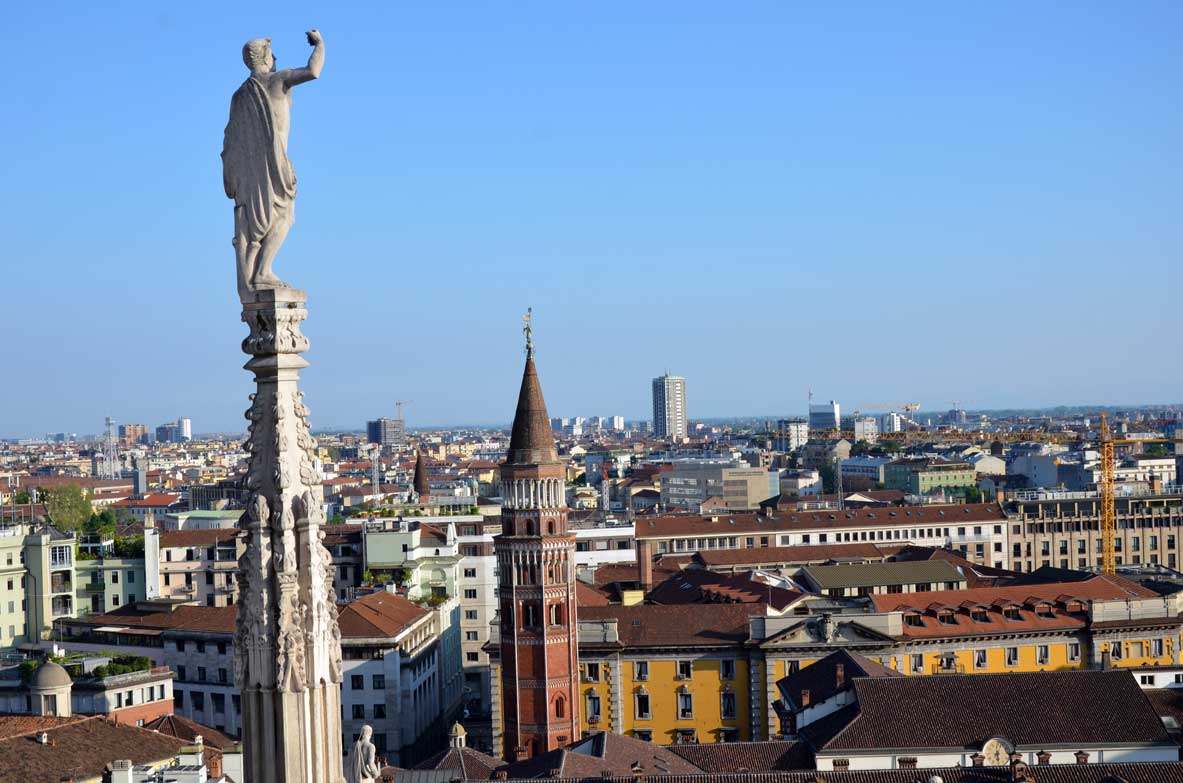
I imagine one of the first things you want to know is how to climb to the rooftop of Milan Cathedral. The terraces of the church are, in fact, one of the best spots to enjoy the beautiful Milan skyline, but also to observe the famous Madonnina and the most beautiful statues up close.
The terraces of Milan Cathedral are accessible every day from 9:00 am to 7:00 pm, with the last entry around 6:00 pm (in summer the hours extend into the evening). Tickets are available at the official ticket office located right at the foot of the church, or you can buy them online and save hours of queuing.
The terraces sit at around 70 metres, a real triumph of spires and breathtaking views: the ideal place to take beautiful pictures or plan a romantic surprise. I advise you to arrive around sunset. For me it was an unforgettable, magical moment to see the rays caress the statues and pinnacles and turn everything golden.
To deepen the visit, I also suggest the underground archaeological area and the beautiful Cathedral Museum, where you will find all the projects, the remains and the parts removed over the various historical periods. It is essential to fully understand the five centuries it took to build the Duomo.
But how do you actually get onto the terraces?
As for the Eiffel Tower in Paris, there are two ways to reach the top of the Milan Cathedral:
- if you feel fit enough, you can climb the terraces on foot, up a staircase of 251 steps, at the end of which you reach the first level of the terraces
- or you can take it easy and use the elevator, which brings you directly to the first level (a few steps still remain to reach the highest point and to come back down).
Now let me tell you a little about the history of this beautiful monument and the most interesting things to see.
2 – Milan Cathedral history
The origins of the Milan Cathedral are very ancient.
As has happened for many other religious buildings, the Cathedral was built on a pre-existing structure. The first church built on this square dates back to the early Christian era: it had five naves and was called Santa Tecla.
Nearby stood the ancient basilica dedicated to Santa Maria Maggiore, which shared the role of cathedral with Santa Tecla.
So why build a new and majestic church?
The decision to build the current Milan Cathedral was taken only in 1386, following the collapse of the bell tower of Santa Maria Maggiore. It was the archbishop of that period, Antonio da Saluzzo, who promised the citizens a new cathedral.
And what happened to the ancient cathedrals?
To make room for the Duomo, unfortunately, the two basilicas were completely demolished, but the remains of the ancient foundations can still be visited in the basement of the current church and are impressive for their size.
Officially the first stone was laid in 1386, but the history of the Duomo and its construction was anything but fast.

3 – The construction of the Milan Cathedral: an ambitious project
Gian Galeazzo Visconti took over the direction of the works for the construction of the Milan Cathedral in 1387. He decided to abandon the bricks foreseen in the Gothic tradition and choose Candoglia marble to give the church an even more majestic and “fashionable” look.
To facilitate the supply of materials, Visconti made even the marble quarries available, and each block destined for the Duomo’s workshop was marked with the initials AUF (Ad usum fabricae) and exempted from taxes. He called masters and architects from all over Europe to work on it.
Not even 10 years later, in 1393, the first capital for the nave was carved.
So why did it take so long to finish building the Milan Cathedral?
There are two reasons for the progressive slowdown in the construction of the Milan Cathedral. On the one hand, there were frequent changes of project. On the other, some wars severely limited the funds for the church. These problems were very common at the time, and the same thing happened to the beautiful Malatesta Temple in Rimini.
A curious fact: Leonardo da Vinci also worked on this site for a while. In 1487-1488 he presented a project (never carried out) for the tiburio, the structure connecting the naves to the base of the main spire.
The conclusion of the work
Only in 1567 did Archbishop Carlo Borromeo put Pellegrino Tibaldi at the head of the construction site, giving new impetus to the resumption of work.
The main spire, designed by Francesco Croce, was completed in 1769 and, five years later, in 1774, the Madonnina of Milan found its place at the highest point. Even today this gilded copper statue dominates the city from its 108.5 metres and has become one of the most recognisable symbols of Milan.
The works of the Milan Cathedral officially ended only in the nineteenth century when, at the orders of Napoleon, the façade was finally completed.
Do you think it ended there?
Well, no!
During the twentieth century, heavy restoration work had to be carried out due to structural problems and the collapse of some parts. Underneath Milan there is a phreatic water table which, together with the vibrations caused by traffic and the subway, risked seriously damaging the building.
For this reason, in 1969, Piazza del Duomo was closed to traffic and the trains running along line 1 of the underground were ordered to slow down.
4 – Milan Cathedral interior: what to see
Perhaps it will surprise you, but the Milan Cathedral is the third-largest church in the world by surface area, after St. Peter’s in the Vatican and the cathedral of Seville. The structure is truly immense and you will notice it as soon as you arrive in Piazza del Duomo. Here are some things you should absolutely notice.
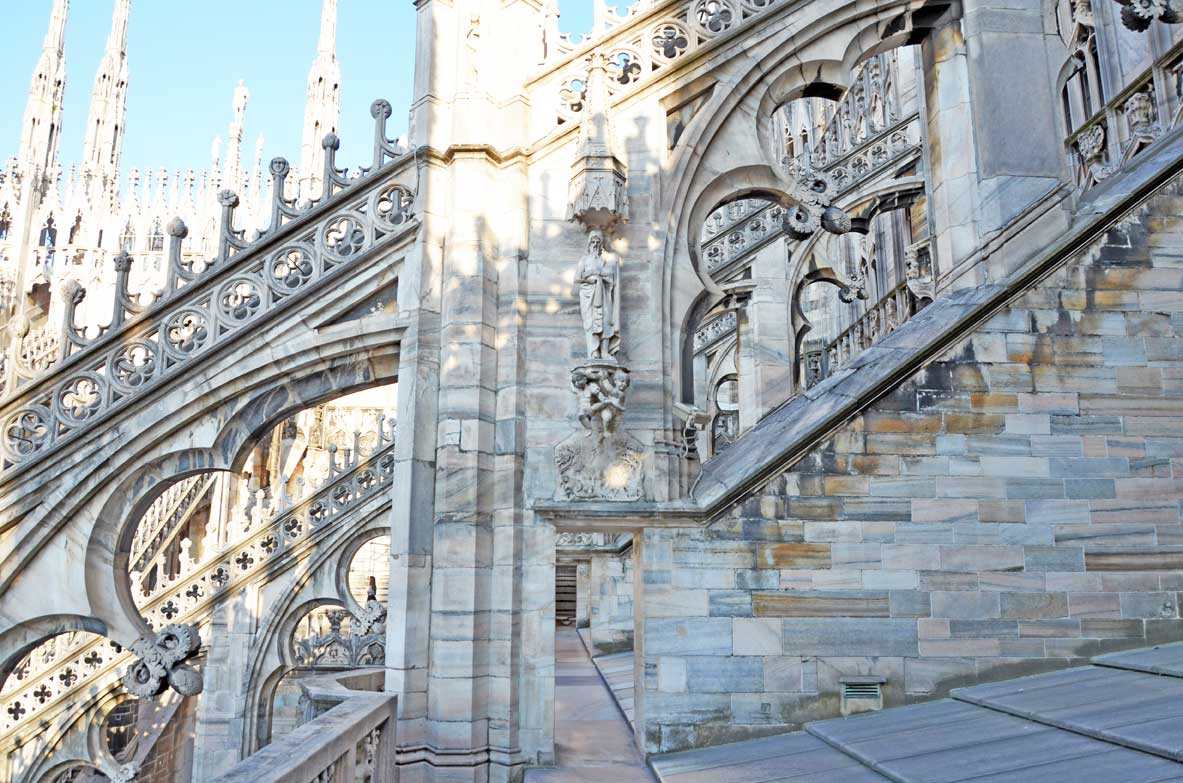
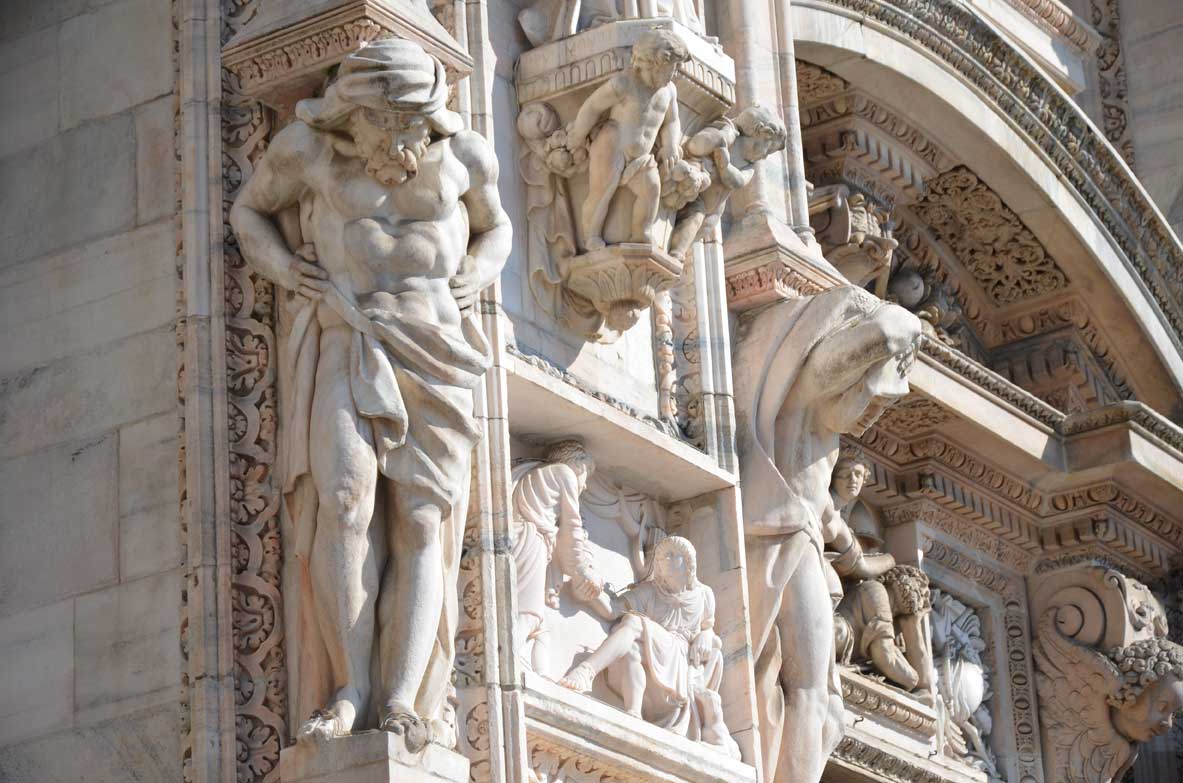
First of all, the Milan Cathedral today is characterised by an absolutely unique blend of styles, which nonetheless feel harmonious and perfectly combined. The prevailing style is Gothic, represented by the 135 spires typical of this architectural current. These elements give the structure a particularly balanced appearance between vertical and horizontal lines.
The façade is a masterpiece of niches and tracery that, playing with the light, create different effects to be admired at every hour of the day.
Inside the Cathedral, the light filters through the large windows, where you will find the history of the most important events of Christianity. There are 55 of them, and observing them is like taking a journey through time: the first were made in the 15th century, while the last date from after the Second World War. If you pay attention, you can even distinguish the various historical periods in which they were made.
One thing that will surprise you is that the Milan Cathedral was one of the first churches to have its windows illuminated even from the inside. I found it wonderful to walk around in the evening and admire these masterpieces from the outside.
The show is truly striking, I’m sure you’ll like it.
5 – The sundial of the Cathedral
Particularly important is the sundial on the floor of the Milan Cathedral. It was installed in 1786 by the astronomers of the Brera Observatory, Giovanni Angelo De Cesaris and Guido Francesco Reggio, and it is a long brass strip that runs through the church from south to north with the various representations of the zodiac signs. At exactly noon, a ray of sunlight entering through a small hole in the south wall strikes the line on the floor.
A curious fact: in the past the sundial was fundamental to city life, because it regulated the time for all of Milan. At exactly noon a gunner fired a cannon shot to tell the people of Milan the precise hour.
As for paintings, unfortunately, you will not find many inside the Cathedral, precisely to reflect the style of European Gothic.
The statues, on the contrary, are the true heritage of this beautiful church, and there are so many that they have not yet been completely studied and catalogued.
That’s why!

6 – The statues of the Milan Cathedral
One of the things that will surprise you the most is the impressive number of statues that decorate the façade and the terraces of Milan Cathedral. Counting the exterior and interior together, there are around 3,400 of them, and they do not represent only saints and blesseds. Among the statues of the Duomo, the stonemasons really let their imagination run wild and, over the centuries, each left their own mark.
If you pay attention, for example, you can find a statue very similar to the current Statue of Liberty in New York, the statue of a dinosaur and even the statue of a pigeon that symbolises the “real” inhabitants of the Duomo.
On the main terrace there is the representation of a historic moment for Italian boxing: you can see two pairs of boxers intent on fighting. One of them has been identified as Primo Carnera, the first Italian boxer to win the heavyweight title.
As per Gothic tradition, on the terraces of the Milan Cathedral you will find numerous representations of monstrous and demonic figures. This should not surprise you, because throughout the Middle Ages these “monsters” were placed on religious buildings to frighten “evil spirits”. The aim was to keep them outside the churches, but they were also used as a moral warning.
Finally, on the staircase leading to the roof, you can observe the faces of some figures of Italian history, including Vittorio Emanuele III, Mussolini and Pope Pius IX.
And of course there is the statue of the Madonnina of Milan, with all its secrets and curiosities.
Want to know them?
7 – Curiosities about the Madonnina of Milan
One of the things I asked myself while visiting the Milan Cathedral was this:
But how did they manage to raise the Madonnina to that height, with the tools they had in the 18th century?
Well, I discovered that this precious gilded copper statue is actually hollow inside. Hoisting a heavier or larger statue would have been impossible, and for this reason several more complex projects were discarded. The original framework is now on display at the Cathedral Museum, since the Madonnina was replaced in 1967 by a more resistant stainless steel structure.
The numbers of the Madonnina are impressive!
The statue is covered with sheets weighing about 400 kg in total, while the internal structure weighs 584. It is exactly 4.16 metres high, and it took 6,750 sheets of gold to cover it entirely during the last restoration.
But the curiosities about the Madonnina of Milan are certainly not over here.
Looking closely, you will notice something really unusual: the Madonnina holds a large halberd in her right hand!
How is that possible?
The halberd next to the Madunin actually has a much more practical function than you might imagine. It is a disguised lightning rod, but it also symbolises the struggle of the church, of which Mary is the mother.
In the iconographic tradition you will never find the Virgin Mary depicted with a halberd, but this instrument, in heraldry, symbolises the one who keeps good watch. A role that the Madonnina of Milan has played for centuries.
To make this protective role even clearer, you should know that, until a few decades ago, no building in Milan could exceed the height of the Madonnina. For this reason, copies of the ancient statue have been placed on the new skyscrapers that now rise in the city.
Finally, one last curiosity about the Milan Cathedral and the Second World War.
During the last conflict, the citizens of Milan decided to cover the Madonnina with rags to prevent its glow from attracting enemy fire. Thanks in part to this precaution, the Duomo suffered only minor, partial damage to the façade.
A real stroke of luck!

Practical information: tickets, hours and dress code
Let’s get to the most concrete part, the one that really matters when you plan your visit.
Tickets (checked in August 2026 on the Duomo’s own site). The complex sells both single tickets and cumulative “passes”. Cathedral and Museum cost €10 (reduced €5), dropping to €8 on Wednesdays. The rooftops cost €16 on foot and €18 by lift (reduced €8 and €9). The archaeological area is €5 and the crypt of San Carlo €3.50. Among the combined tickets, the two-day Combo Lift costs €26 (reduced €13) and the Culture Pass €15. Good news: since 2025 pre-sale fees have been abolished, so online you pay exactly what you would at the desk. My advice is still to book online: you skip the line at the ticket offices, which on weekends and in high season can be really long.
Terraces on foot or by elevator? The 251 steps of the staircase are less demanding than they sound and offer close-up views of the spires that you don’t get from the elevator. But if your knees are tired or you are travelling with children, the elevator is very convenient: it takes you to the first level, then a few steps separate you from the highest point.
Dress code. To enter the cathedral, shoulders and knees must be covered: avoid tank tops and short shorts, or bring a shawl. For the terraces alone, there is no dress code.
Opening hours. The main entrances are open every day from 9:00 am to 7:00 pm, with the last ticket sold about an hour before closing. In summer the terraces stay open into the evening: the sunset up there, believe me, is worth the ticket on its own.
8 – How to get to Milan Cathedral
Despite being one of the most important cities in Italy, Milan is relatively small and well served by public transport.
Therefore, if you arrive by car, I advise you to leave it outside the historic centre and continue your visit to Milan using the Metro. The parking lots closest to Piazza Duomo are those of San Babila, Corso Vittorio Emanuele or Piazza Diaz.
If you arrive by train in Milan, you can easily reach the Duomo from Milano Centrale station using line 3 (yellow) and getting off at the Duomo stop.
From Piazza Cadorna, instead, you can take line 1 (red) and get off at the Duomo stop as well.
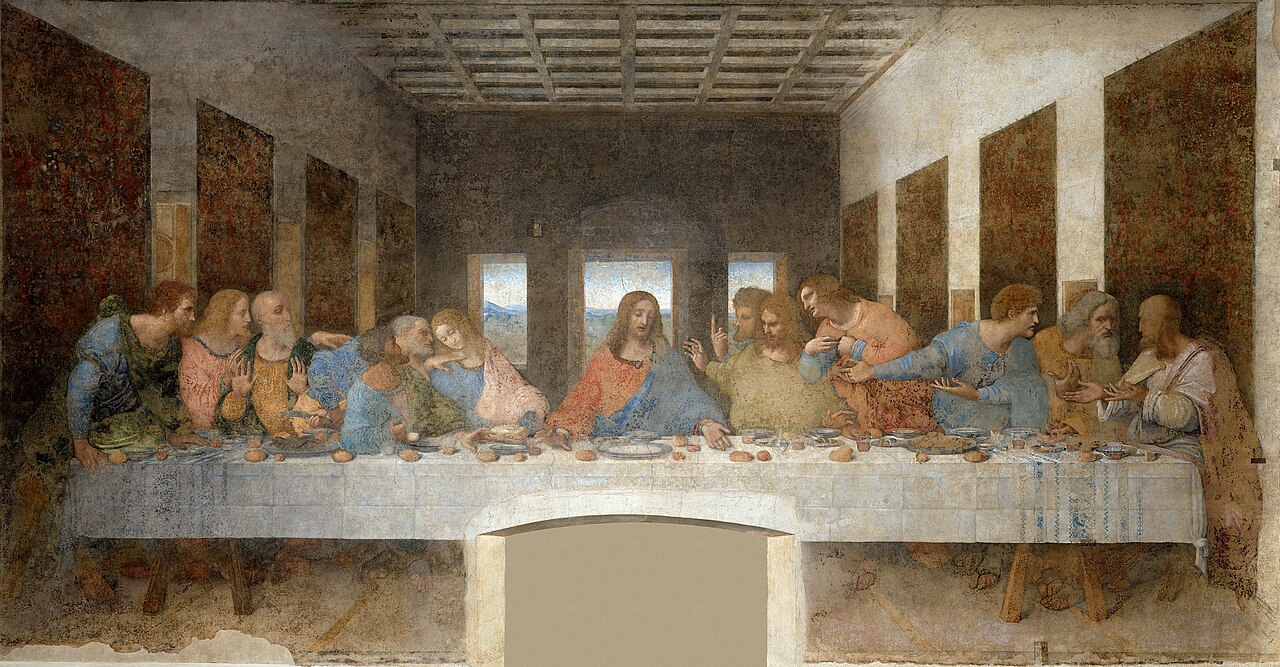
If you still have time after climbing the terraces, spend a couple of hours at the Pinacoteca di Brera, a few minutes away by metro: it is the perfect way to round off a day of art in Milan. The other stop to factor in is Leonardo’s Last Supper at the Cenacolo Vinciano, but that one has to be booked well ahead: it is not a visit you can improvise at the end of the day.
And if you happen to be in town in spring, don’t miss the seasonal events and blooms that liven up the surroundings.